

5 Reasons to Roll Covered Calls
How and why to roll covered calls to lock profits, avoid assignment, extend income, manage downside, and adapt to market moves.
Rolling covered calls lets you adjust your options strategy based on market conditions or personal goals. It involves closing your current call and opening a new one with updated terms, such as a different strike price or expiration date. Here are five key reasons why investors use this approach:
- Lock in Profits: Close calls that have lost most of their value to secure gains early and sell new ones for additional income.
- Avoid Assignment: Prevent your shares from being called away by rolling up to a higher strike or out to a later expiration.
- Extend Income Potential: Keep generating premiums by rolling to later expirations before your current call expires.
- Manage Downside Risk: Offset losses when a stock drops by rolling down to a lower strike for fresh premium.
- Adjust to Market Conditions: Align your position with market trends, whether prices are rising, falling, or staying flat.
Rolling covered calls turns a passive income strategy into an active tool for managing positions, helping you fine-tune your returns while addressing risks and opportunities.
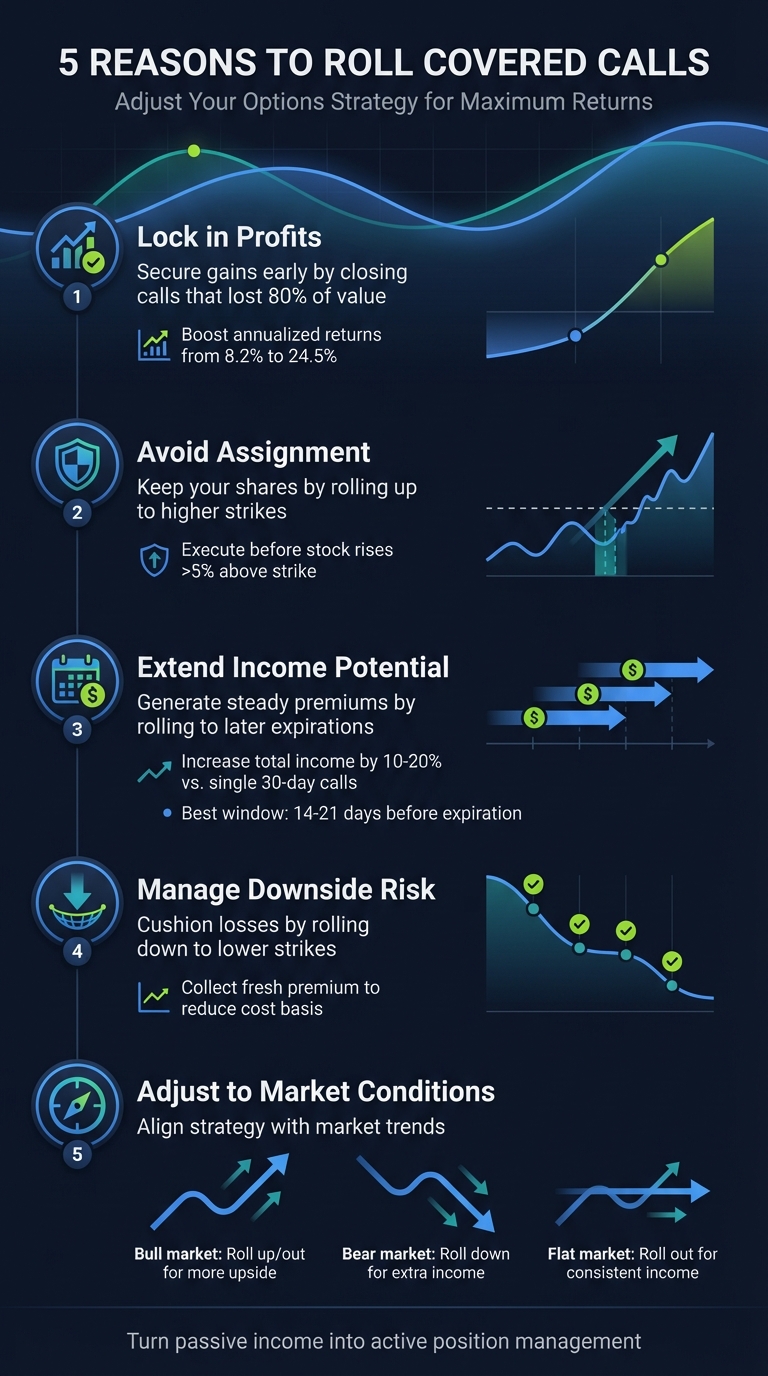
5 Key Reasons to Roll Covered Calls in Options Trading
1. Lock in Profits
When a covered call loses most of its value, you don’t need to wait until expiration to secure your gains. By buying back the call at a lower price than you initially sold it for, you can lock in profits right away. This is done through a "buy-to-close" order to close out your existing call, followed by a "sell-to-open" order to initiate a new call - often with a lower strike price or a later expiration. This process resets your position, allowing you to maintain a steady income stream.
A common strategy is the 80% profit threshold: if the call you sold has lost 80% of its value due to time decay or a drop in the stock price, buying it back lets you capture that gain at a low cost. You can then sell another call closer to the current stock price to collect additional premium.
Take the November 2025 Salesforce (CRM) example from the introduction. By rolling to a lower strike price, the investor increased their annualized return from 8.2% to 24.5% - a significant boost.
The goal here is to achieve a net credit - where the premium from selling the new call outweighs the cost of closing the old one. This not only puts extra cash in your account immediately but also adjusts your trade to reflect current market conditions.
sbb-itb-a9ac3c2
2. Avoid Assignment
When the stock price climbs above your call's strike price, the risk of assignment becomes very real - unless you decide to roll your position. If you're still optimistic about the stock's future and want to hold on to your shares for potential gains, rolling the call "up and out" can be a smart move.
Here's how rolling works: you buy-to-close your current call option and simultaneously sell-to-open a new one with a higher strike price and a later expiration date. This adjustment replaces your earlier obligation with a new one at a higher strike, while the extended expiration helps generate additional premium. Often, this premium can offset the cost of buying back the original call, and in some cases, you may even end up with a net credit.
"The only way to avoid assignment for sure is to buy back the 90-strike call before it is assigned, and cancel your obligation." – Options Playbook
To reduce the risk of unfavorable price swings during the transition, it's best to execute this as a single spread order rather than two separate trades. This ensures the trade aligns with your terms. Also, keep an eye on ex-dividend dates - assignment risk tends to spike if the intrinsic and extrinsic value of the call is lower than the dividend amount.
However, if the stock surges more than 5% above your strike, rolling might become prohibitively expensive. In such cases, allowing the assignment and reallocating your capital could be the more practical choice.
This approach not only helps protect your shares but also provides a more seamless way to adjust your position using covered call risk management techniques.
3. Extend Income Potential
Rolling a covered call to a later expiration date can help create a steady income stream from the same shares. Instead of waiting for your call to expire worthless before selling a new one, rolling allows you to immediately collect more premium and keep your position active.
After focusing on locking in profits and avoiding assignment, this step adds another layer to your overall strategy. The goal is to execute a credit roll - where the premium from the new call exceeds the cost of buying back the existing one. For instance, in November 2025, options trader Gavin McMaster demonstrated this with Apple (AAPL). He rolled a $260 strike call expiring in three days to a new expiration two weeks later. The buyback cost $0.47, but the new call brought in $2.65, resulting in $2.15 of additional income. This example highlights how adjusting your position to match market conditions (or using AI-powered portfolio analysis to model scenarios) can keep your strategy generating returns.
Strategic rolling can increase your total income by 10% to 20% compared to simply selling a single 30-day call and letting it expire. Many traders use the 50% rule - buying back the short call once it reaches 50% of its maximum profit and rolling it to a later date. This approach captures most of the time decay while resetting the "theta clock" to collect higher premiums again.
Timing is crucial. The best window for rolling is typically 14 to 21 days before expiration, when most of the profit has been captured but new calls still offer attractive premiums. Waiting too long - especially in the final one to three days - can lead to wider bid-ask spreads, reducing the profitability of the roll. Additionally, each roll comes with friction costs like commissions and slippage, so it's more efficient to use a single spread order instead of separate trades. By managing these factors and leveraging portfolio intelligence tools, you can enhance both control and returns.
4. Manage Downside Risk
When a stock takes a hit, rolling down your call options can help cushion the blow by generating fresh premium. This involves buying back your current out-of-the-money call and selling a new one at a lower strike price. Using an options strategy planner can help you visualize these adjustments and calculate the new risk profile (similar to how you would calculate risk for cash-secured puts). The premium collected acts as a cash buffer against unrealized losses.
This approach doesn't just boost income - it also helps reduce losses during market downturns. Take the example from November 2025, when Barchart analyzed a defensive roll for Salesforce (CRM). An investor holding a $265 call saw the stock drop, leaving the call valued at only $0.90. By buying back that call and selling a new one with a $250 strike for $2.67, the trader pocketed an additional $1.75 in premium. This extra income created a larger cushion against the stock's decline.
Each time you roll for a credit, you effectively lower your cost basis, which reduces your breakeven point. For instance, if you initially bought shares at $335 and collect $2.00 in premium, your cost basis drops to $333. Add another $0.25 credit, and it falls further to $332.75. These incremental adjustments help protect against downside risk.
However, rolling down comes with a trade-off - it limits your upside. As one analyst explains, while rolling down increases income, it also sacrifices potential gains if the stock rebounds. This is why it’s often recommended to roll down when a call has lost about 80% of its value.
This strategy allows you to stay in the game even when the stock isn't performing well. Instead of selling your shares at a loss, you retain ownership and generate additional income to help offset the decline.
5. Adjusting to Market Conditions
Markets can shift in the blink of an eye, and your covered call strategy should be flexible enough to keep pace. Rolling offers a way to adjust both the strike price and expiration date of your options, ensuring your approach aligns with the current market landscape. This flexibility means you're not tied to a single strike or expiration but can tweak your strategy as the market evolves.
When the market is climbing, you might consider rolling up or out - choosing a higher strike price with a later expiration. This approach allows you to capture more potential upside if the stock continues to rise, all while extending your income opportunities. On the flip side, if prices are falling, rolling down to a lower strike price can bring in extra premium to help offset losses. However, this move does limit your ability to fully recover if the stock rebounds.
The trick lies in tailoring your rolling strategy to the market's mood. In a bull market, rolling up or out can help you avoid assignment and benefit from rising prices. In a bear market, rolling down provides additional income to soften the blow of declines. And in flat or sideways markets, rolling out at the same strike can generate consistent income through time decay.
This ability to adjust complements other key strategies like profit-taking and risk management. By refining your rolling approach, you turn a static position into a dynamic one, capable of responding to the market's twists and turns. It’s another tool to keep your overall strategy sharp and aligned with changing conditions. Following a covered call checklist can help ensure you've accounted for all variables before making these adjustments.
Using Tools for Roll Strategies
Improving your roll strategy becomes much simpler when you have tools that streamline the decision-making process. Managing roll opportunities can be a daunting task, especially when you’re juggling expiration dates, profit targets, strike prices, and the financial implications of each move. Trying to handle all these details manually across multiple positions can quickly feel overwhelming.
This is where platforms like ThetaEdge come into play. ThetaEdge connects securely to over 80 brokerages using read-only access, analyzing your actual portfolio and identifying roll opportunities automatically. For example, it flags when calls are approaching their 50% profit target or nearing the 21-day-to-expiration mark. Each opportunity is presented with a breakdown of critical factors like strike price, expiration, premium, assignment probability, and breakeven points. This detailed view eliminates the need for manual calculations of complex metrics like Greeks, giving you a clearer picture of the trade-offs involved before making a decision. The platform’s "Optimization Ideas" feature further simplifies the process by highlighting positions that are ideal for rolling, turning what used to be a time-intensive analysis into a quick and actionable review.
As ThetaEdge describes it:
"Options Intelligence is a new kind of analytical layer... It connects to your brokerage, reads your holdings, and continuously computes the income opportunities, risk trade-offs, and position management decisions that used to require a professional analyst." - ThetaEdge
The platform doesn’t just stop at identifying opportunities - it provides full lifecycle management for your positions. It monitors your portfolio and alerts you when market conditions change or when new opportunities emerge. While you retain full control over executing trades through your brokerage, ThetaEdge handles the complex analysis, making it easier and faster to adjust your covered call positions. This automated support allows you to adapt to market shifts effectively, helping you lock in profits and manage risks with greater confidence.
Conclusion
Rolling covered calls offers a structured way to manage positions while boosting income potential and maintaining control. This approach provides five key strategies: locking in profits when calls lose most of their value, avoiding assignment to retain your shares, extending income potential as expiration nears, managing downside risk during price drops, and responding to changing market conditions. Each strategy addresses common challenges, equipping traders with practical tools for active management.
What sets rolling strategies apart is their adaptability. Unlike passive methods that might miss opportunities or expose you to unnecessary risks, these techniques rely on informed decision-making and data-driven insights. Rolling is about balancing trade-offs and executing moves that align with your goals.
Whether you're rolling down to improve returns during a downturn, rolling up and out to capture more upside, or extending premium collection, the process remains consistent: close the current call and open a new one tailored to the market's current state. Success depends on timing and strike selection, both of which can significantly influence outcomes. With professional trading tools, self-directed investors can fine-tune these strategies to respond effectively to market shifts.
Regularly review your positions, adjust strikes and expirations as needed, and use profit/loss charts to evaluate scenarios before making decisions. Tracking your performance over time will help refine your approach. Platforms like ThetaEdge can simplify this process with automated analysis and streamlined execution, enabling you to stay proactive in changing market environments.
FAQs
When should I roll a covered call?
When a covered call no longer aligns with your goals or market view, rolling it might be a smart move. For instance, if the stock price climbs above the strike price, there's a risk of your shares being called away. In this case, rolling to a higher strike or a later expiration can help you manage that risk while possibly boosting your returns.
Rolling can also be a practical way to extend your income opportunities or tweak your position as the market evolves. It’s about staying flexible and ensuring your strategy continues to work for you.
Will rolling always cost a debit, or can it be a credit?
When rolling a covered call, the outcome can be either a debit or a credit, and this depends on the specifics of the trade and current market conditions. It’s not always a debit transaction. If the premium you collect from opening the new position is higher than the cost of closing the existing one, the roll can actually result in a credit.
What are the tax consequences of rolling covered calls?
The tax treatment of rolling covered calls hinges on how the options conclude - whether they’re exercised, expire, or are repurchased. Typically, any profits or losses from these actions are classified as capital gains. However, the exact tax implications can differ depending on the specifics of the transaction. For personalized advice, it’s best to consult a tax professional who can provide guidance suited to your circumstances.