

Dynamic Exit Strategies for Covered Calls
Practical rules for exiting covered calls—when to close or roll, 50% profit targets, timing around 21 DTE, and handling volatility and earnings.
When managing covered calls, the key to success lies in knowing how and when to exit your positions. While covered calls and cash-secured puts both generate income, covered calls specifically involve selling call options against stocks you own, but market shifts - like sudden price increases or volatility changes - can impact your strategy. This guide focuses on dynamic exit strategies to help you protect profits, manage risks, and stay aligned with your investment goals.
Key Takeaways:
- Exit Timing Matters: Closing or rolling positions around 21 days to expiration can reduce assignment risks while still benefiting from time decay.
- Profit and Risk Balance: Many traders aim to secure 50% of the premium before closing a position, minimizing exposure to reversals or unexpected volatility.
- Rolling Strategies: Adjust your covered calls by rolling to new strikes or expirations, keeping income flowing while managing assignment risks.
- Volatility Events: Prepare for earnings reports or market swings by exiting or rolling positions to avoid surprises.
- Automation Tools: Platforms like ThetaEdge can simplify decision-making with real-time data, risk analysis, and automated alerts.
The goal is to maintain control over your trades, using well-planned strategies to adapt to changing market conditions. Whether you're targeting steady returns or higher yields, disciplined exit rules are essential for achieving consistent results.
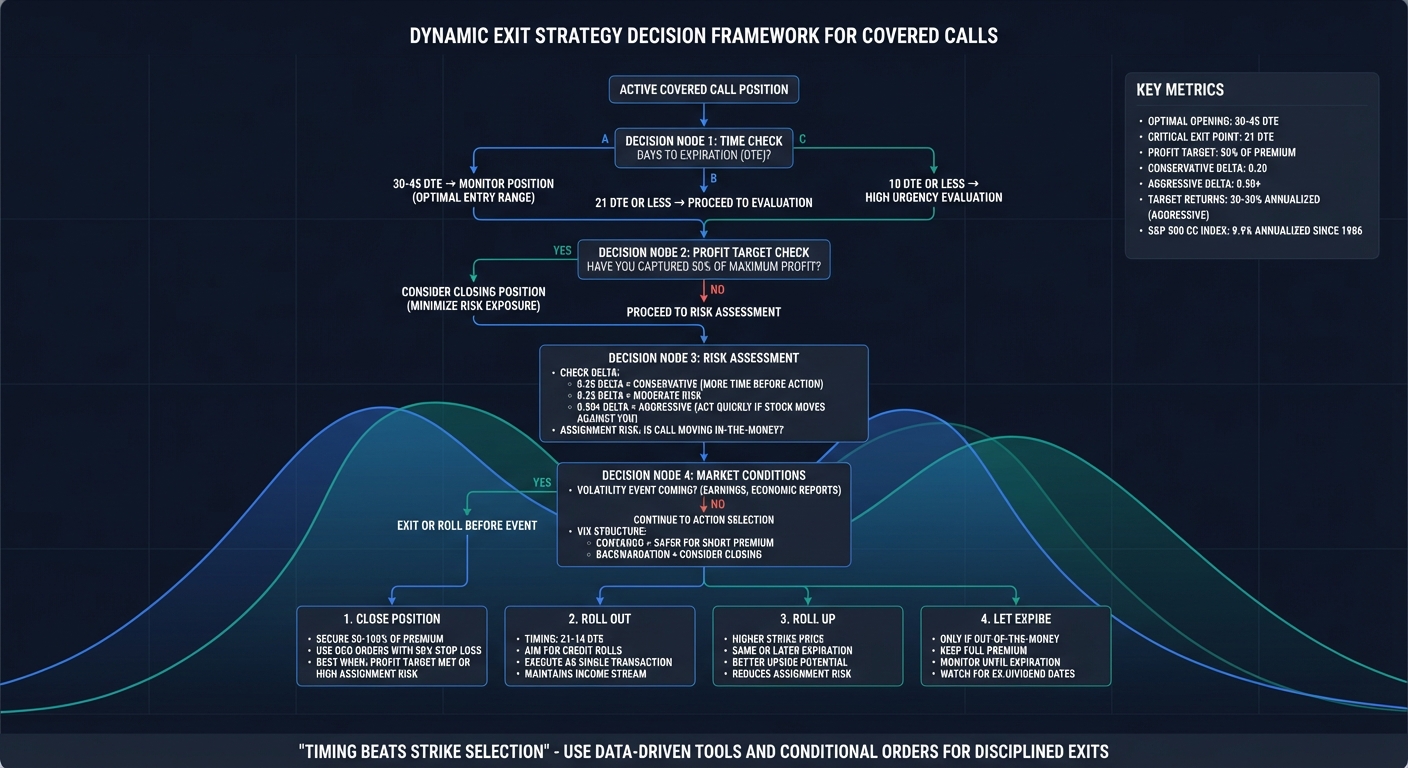
Dynamic Exit Strategy Decision Framework for Covered Calls
Basic Principles of Dynamic Exit Strategies
A dynamic exit strategy involves adjusting your covered call positions as market conditions evolve. The market can shift unexpectedly, and your exit decisions should reflect those changes in real time.
Staying adaptable is crucial. The conditions that made sense when you opened a position might not hold up days later. For example, if you initially sold a call with a 0.25 delta (indicating a 25% chance of expiring in-the-money), an unexpected rally could increase that probability significantly. Holding passively in such a scenario might mean losing your shares at a less-than-ideal price and missing out on further gains. On the flip side, if volatility drops and the option loses value faster than expected, closing early allows you to secure profits and reallocate capital. Below, we’ll explore how to adapt your positions to these shifting dynamics.
Adapting to Market Conditions
To manage your strategy effectively, consider how stock price, volatility, and time decay interact. When the stock price rises sharply, your call moves closer to being in-the-money, raising the risk of assignment. If the stock stays flat or declines, the call's value diminishes, benefiting your position. At the same time, implied volatility plays a major role - higher volatility increases option premiums, while lower volatility reduces them.
Time decay, or theta, becomes more pronounced as expiration nears. Traders often prefer 30–45 days to expiration (DTE) when opening positions because theta is strong without introducing excessive gamma risk. However, as expiration approaches - around 21 days to go - assignment risk grows, and time decay slows. This is a common point to either close or roll the position. If you’re holding a position with just 10 days left and the stock isn’t moving in your favor, waiting until expiration is unlikely to improve the outcome.
"Timing beats strike selection." – Days to Expiry Trading Team
Weighing Risk Against Reward
As market conditions shift, so does the balance between potential reward and risk. Each exit decision boils down to one critical question: Is the potential reward worth the remaining risk? A widely used guideline is to close or roll your position once you’ve captured 50% of the maximum profit. For instance, if you sold a call for $2.00 and it’s now worth $1.00, you’ve already secured half the premium while minimizing time exposure. Holding out for the remaining $1.00 exposes you to assignment risk, unexpected volatility, and market reversals.
Your strike and delta choices also influence when to adjust your position. If you sold a call with a 0.50+ delta, aiming for aggressive annualized returns of 20–30% or higher, you’ll need to act quickly if the stock moves against you. On the other hand, conservative 0.20 delta strikes are better suited for retaining shares, giving you more leeway before taking action. The ultimate goal is to align your exit strategy with your initial objectives, ensuring your moves are consistent with your broader plan.
sbb-itb-a9ac3c2
Exit Techniques for Covered Calls
When managing covered calls, having a clear options strategy for exiting a position is critical. The right technique depends on factors like market conditions, time left until expiration, and how much profit you've already locked in. Here are three practical methods to help you safeguard both your gains and your stock position.
Setting Up Conditional Orders
Conditional orders are a great way to automate decisions during periods of market volatility. For instance, a One-Cancels-Other (OCO) order links two actions: a profit-taking limit order based on the 50% profit rule and a stop-loss order to limit losses if the market moves against you. Trailing stops provide an additional layer of security by adjusting your exit point as the option's value rises. If the price drops by a set amount - say, $2.00 - the trailing stop triggers, locking in your gains. You can also use contingent orders tied to key support levels to fine-tune your strategy. Once you've mastered automated exits, rolling your covered calls can offer even more flexibility.
Rolling Your Covered Calls
Rolling is another useful tool for adjusting your positions. This involves closing your current call and opening a new one with a different strike price or expiration date. It’s a way to maintain income while managing assignment risk. A good rule of thumb is to use time-based exits and roll your position between 21 and 14 days before expiration. This timing allows you to benefit from time decay while premiums are still worthwhile. To keep costs down, execute both the closing and opening trades as a single transaction, often referred to as a "roll order." Aim for credit rolls, where you collect additional premium, and reserve debit rolls for situations where the new strike price offers significantly better upside potential.
Managing Positions Around Volatility Events
Volatility events, like earnings announcements or major economic reports, can create unpredictable price swings. Preparing for these moments is key. Decide whether to exit, roll, or hold your position based on factors such as the VIX term structure. When the VIX is in contango - where near-term volatility is lower than longer-term expectations - short premium strategies are generally safer. However, during backwardation, when short-term volatility is higher, it may be wiser to close positions or avoid opening new ones altogether.
"Volatility is not risk to be eliminated, but information to be respected. When markets suppress it through structure, they trade resilience for illusion." – Joshua Barone, Investment Adviser Representative, Savvy Advisors
Additionally, keeping an eye on Net Dealer Gamma Exposure (Net GEX) can offer valuable clues. High negative gamma levels often signal potential for sharp, unhedged price movements, while gamma floors may act as support. If an upcoming event pushes the stock price toward your strike, consider closing the position early to reduce the risk of assignment.
Using ThetaEdge for Better Exit Decisions
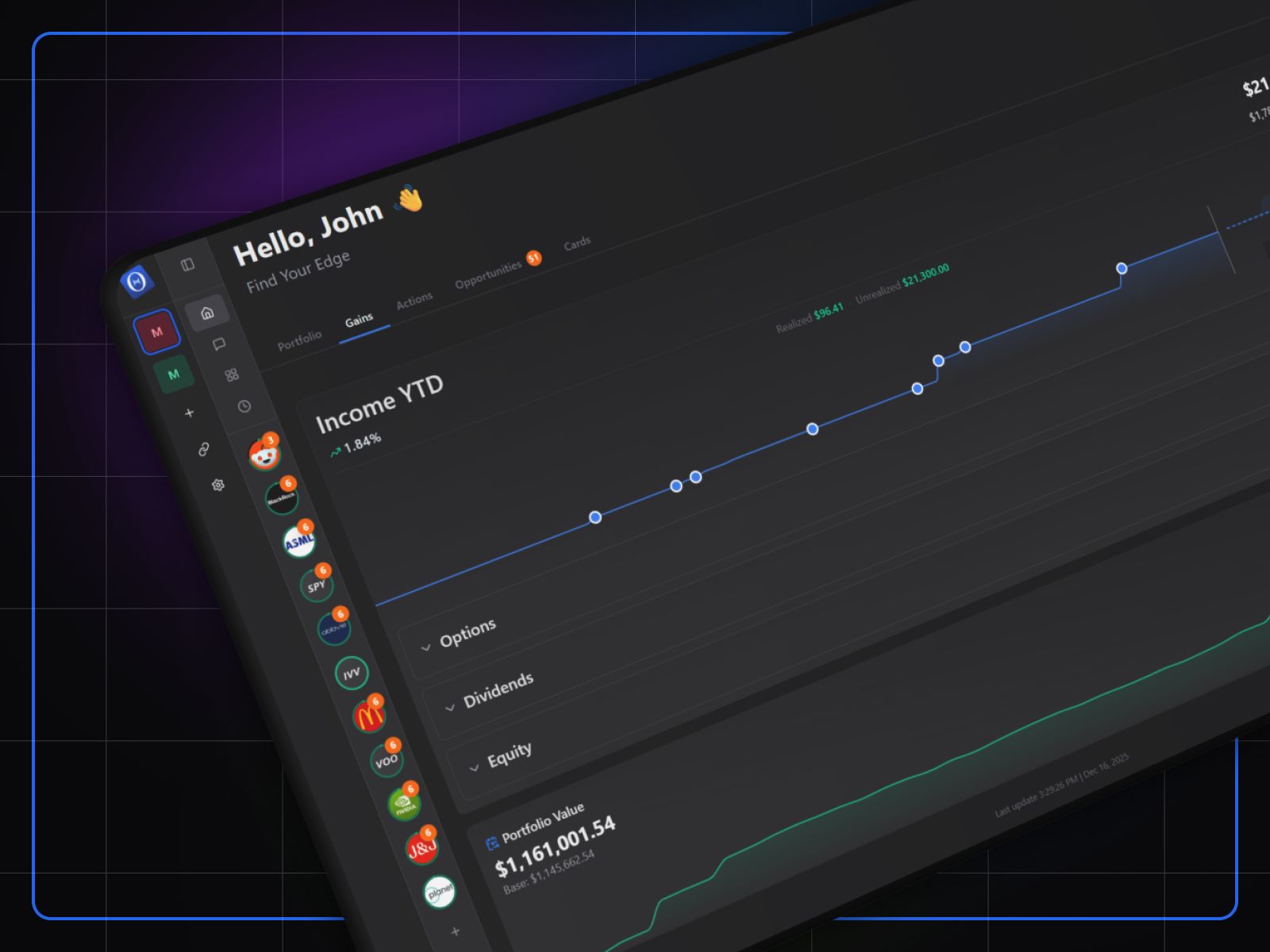
Fine-tuning your exit strategy can be a game-changer, especially when paired with advanced analytics. ThetaEdge offers self-directed investors access to professional-grade tools that leverage real-time data. By integrating live portfolio data, market feeds, and AI-driven insights, ThetaEdge ensures you make informed decisions without giving up control of your funds. With read-only access to over 80 brokerages, the platform provides a secure way to analyze your positions.
Risk and Reward Analysis Tools
Understanding your portfolio's risk exposure is key when deciding whether to exit, hold, or roll a covered call. ThetaEdge provides a comprehensive overview by calculating portfolio-wide Greeks - delta, gamma, theta, and vega - so you can see how market shifts impact your overall position. Each trade opportunity and active position is paired with critical metrics like assignment probability, downside buffer, and breakeven points, offering a transparent look at your risk profile. The platform also flags concentration risks, alerting you when a single stock or sector dominates your exposure. With over $26 million in assets analyzed, $1.5 million in tracked covered-call premiums, and an average portfolio size of $300,000, these features bring a data-focused approach to managing exits.
Automated Roll Strategy Analysis
ThetaEdge goes beyond risk assessment by streamlining roll decisions. Its automated roll strategy continuously monitors your positions, identifying optimal rolling opportunities. Detailed credit and debit analyses, assignment probabilities, and risk metrics are presented for each potential roll. Smart Alerts, written in simple language like "notify me when XYZ drops below $50" or "alert me when implied volatility exceeds 30%", ensure you never miss a critical moment. The platform's Thetix AI assistant also allows you to test "what-if" scenarios using your actual portfolio data. With tax-aware roll analysis and cost-basis tracking, it simplifies the often complex fiscal considerations tied to exit strategies.
Key Takeaways for Managing Covered Call Exits
Adaptability is key: Sticking to rigid plans can lead to missed opportunities or higher losses. Depending on the market, your exit strategy might involve letting calls expire, closing them early, rolling them out or up, or fully unwinding the position. For instance, allowing an out-of-the-money call to expire lets you keep the premium, while rolling out or up can capture additional extrinsic value.
Balancing risk and reward should be a constant focus. A common approach is to set profit goals between 50–100% of the premium while using OCO (One-Cancels-the-Other) orders with a 50% stop loss. Trailing stops can also help, adjusting dynamically as prices move (e.g., lowering from $5.00 to $3.50). Additionally, keeping an eye on time decay is vital. Theta, which measures time decay, accelerates significantly in the final 21 days before expiration. This makes it a prime time to either close or roll positions to mitigate early assignment risk.
Account for event-driven risks like ex-dividend dates and earnings reports. In-the-money calls are more likely to face early assignment near ex-dividend dates, while earnings announcements can cause large price gaps beyond your strike. Conditional orders, such as setting triggers for when a stock drops below $125, can help enforce disciplined exits without requiring constant monitoring. These measures align well with the dynamic adjustments mentioned earlier.
Leverage data-driven tools to enhance decision-making. Platforms like ThetaEdge provide insights into portfolio-wide Greeks, assignment probabilities, and automated roll strategies, removing much of the guesswork. With over $26 million in assets analyzed and $1.5 million in tracked covered-call premiums, tools like automated roll analysis and Smart Alerts (e.g., notifications when a stock falls below $50) can help ensure decisions are based on data, not emotions. Historical data also supports this approach - the S&P 500 covered call index has delivered a 9.9% annualized yield since 1986, with about two-thirds the volatility of a traditional buy-and-hold strategy. This demonstrates how systematic, flexible exit strategies can be highly effective.
FAQs
Should I close or roll my covered call?
Deciding whether to close or roll your covered call comes down to your market view and risk tolerance. If you believe the stock still has potential and want to keep generating income while avoiding assignment, rolling the position could be a smart choice. On the other hand, closing the call might make sense if the stock has reached your profit target or if market conditions become riskier. Tools like ThetaEdge can assist in analyzing which decision fits best with your overall strategy.
How do I pick my profit target and stop loss?
To determine a profit target, focus on areas where market conditions indicate a good opportunity to exit, such as key support or resistance levels or predefined profit zones. For setting a stop loss, keep an eye on your portfolio’s Greeks - like Delta and Theta - and adjust these levels based on your risk tolerance, market volatility, and technical indicators. These approaches ensure that your exit points align with market behavior and your financial objectives, helping you strike a balance between generating income and managing risk.
How should I handle earnings or ex-dividend risk?
Managing earnings or ex-dividend dates is a critical part of running covered call strategies. These events can lead to higher chances of early assignment or sudden shifts in option prices, which might catch you off guard.
To navigate these risks, steer clear of selling short-term in-the-money calls right before an ex-dividend date or an earnings report. These situations often tempt buyers to exercise early to capture dividends or react to anticipated price swings. Instead, consider selling out-of-the-money calls with shorter expirations. This approach helps reduce the likelihood of surprise assignments and limits exposure to sharp price movements.
The key is staying informed. Keep track of these important dates and tweak your strategy to stay one step ahead.