

How Early Exercise Impacts Covered Call Strategies
How early exercise can disrupt covered-call income and what to do: monitor time premium and ex-dividend dates, roll positions, and choose strikes wisely.
Covered calls generate income by selling call options on stocks you already own, but early exercise can disrupt this strategy. Early exercise occurs when an option holder exercises their right to buy shares before the option expires, often to secure dividends or lock in intrinsic value. This can lead to losing your shares, forfeiting time premium, and facing unexpected tax consequences.
To manage this risk effectively:
- Monitor time premium and ex-dividend dates: Early exercise is more likely when time value is minimal or dividends exceed the option's remaining premium.
- Use rolling strategies: Buy back the current call and sell a new one with a later expiration or higher strike price to maintain your income and reduce assignment risk.
- Select strike prices wisely: Lower delta strikes (e.g., 0.20) reduce assignment chances but offer lower premiums, while higher delta strikes (e.g., 0.40) increase potential income but come with higher risks.
Tools like ThetaEdge can simplify tracking time premiums, dividend dates, and assignment probabilities, helping you make better decisions and protect your income stream.
What Is Early Exercise and When Does It Occur?
Early Exercise Defined
Early exercise happens when the holder of an American-style option decides to exercise it before its expiration date. This results in assignment and the immediate delivery of shares. It's a feature unique to American-style options, which include nearly all equity and ETF options in the U.S. In contrast, European-style options only allow exercise at expiration.
Most option holders steer clear of early exercise because it means giving up the intrinsic vs extrinsic value of the option - unless specific circumstances, like dividends, make it worthwhile:
"I WOULD NEVER, exercise a call option prior to expiration – UNLESS it is to capture a dividend."
This sets the stage for understanding the key reasons behind early exercise.
Main Triggers for Early Exercise
Certain market conditions can lead to early exercise, with dividend capture being the most common reason. When a stock is about to pay a dividend, call option holders might exercise just before the ex-dividend date to become shareholders of record and collect the dividend. This is particularly true if the dividend exceeds the option's remaining time premium. For instance, in May 2015, a trader holding Visa (V) shares had sold a May $66.00 call. The call was exercised early on May 12, allowing the holder to claim the dividend.
Another common scenario involves deep in-the-money calls with minimal extrinsic value, especially in the final 0–3 days before expiration. In these cases, option holders often exercise early to lock in intrinsic value and avoid complications from wide bid-ask spreads.
Understanding these triggers is essential for covered call writers who want to manage early exercise risks and protect their income strategies.
sbb-itb-a9ac3c2
How Early Exercise Affects Covered Call Writers
Loss of Stock Position and Time Premium
When a call is exercised early, it comes with a notable downside for the writer: you lose out on the remaining time premium. While you receive the strike price for your shares, the extrinsic value tied to time decay essentially evaporates. The option holder takes advantage of the intrinsic value immediately, leaving you without the additional premium you might have collected had the option expired naturally.
This early action also means your shares are removed from your account without prior notice. If you intended to hold those shares for long-term growth or income, you'll likely face the inconvenience of repurchasing them - often at a higher price - and incurring additional transaction fees. As Mike Scanlin, Founder of Born To Sell, puts it:
"Normally, having stock called away is a result that covered call investors look forward to. It means they have achieved the best possible outcome. To get this result sooner than the expiration day is considered a good thing."
However, for some investors, this early sale can disrupt broader strategies and reduce immediate returns.
Effects on Income Plans and Multi-Leg Positions
The impact of early exercise goes beyond losing time premium. It can derail your income plans and throw off complex strategies. For instance, if the call is exercised before the ex-dividend date, you lose the dividend payment, as the shares are transferred to the option holder. This unexpected loss of both the stock and the dividend can significantly shrink your expected returns.
The disruption is even more pronounced in multi-leg strategies. As The Options Playbook explains:
"Early assignment on a short option in a multi-leg strategy can really pull a leg out from under your play."
Take a diagonal spread, for example. If the short call is exercised early, you're left holding only the long call. This unintended shift changes the risk profile of your position, potentially exposing you to outcomes you hadn't planned for.
Additionally, early assignment can trigger an unplanned tax event. Selling your shares earlier than expected might result in a realized capital gain or loss, complicating your broader tax strategy.
Expiration vs. Early Exercise
The table below highlights the key differences between normal expiration and early exercise to help you understand the broader implications.
| Feature | Normal Expiration | Early Exercise (Assignment) |
|---|---|---|
| Premium Retention | Writer keeps 100% of the premium (intrinsic + time value) | Writer forfeits remaining time premium |
| Stock Position | Held until expiration; sold only if in-the-money at close | Shares are removed unexpectedly before expiration |
| Dividend Rights | Writer receives dividends if held past ex-dividend date | Writer often loses the dividend if exercised before the ex-dividend date |
| Tax Timing | Tax event occurs at a predictable time | Tax event is triggered prematurely and unexpectedly |
| Strategy Integrity | Multi-leg strategies remain intact until expiration | Early exercise can disrupt multi-leg strategies |
| Profit Realization | Profit is realized at the end of the contract term | Maximum profit (strike price plus premium) is realized sooner |
How to Reduce Early Exercise Risk
Track Time Premium and Dividend Dates
To avoid unexpected assignments, keep an eye on two key factors: the remaining time premium and the upcoming ex-dividend date. The time premium, which represents the extrinsic value of your option, acts as a buffer against early exercise. As Mike Scanlin, Founder of Born To Sell, puts it:
"Basically, if there is even 1 penny of time premium remaining in the option, the option holder is better off selling the option than exercising it."
However, when the dividend exceeds the time premium, early exercise becomes appealing. This creates what traders call the "danger zone", typically occurring 2–3 days before the ex-dividend date.
If the time premium falls below $0.30 per contract and you're within 7–14 days of expiration, the risk of assignment increases significantly. To stay ahead, set reminders 5–10 days before the ex-dividend date for each position. Be ready to close or roll any in-the-money calls where the time premium has dropped below the dividend amount. If the erosion of time premium signals heightened risk, rolling your position can help protect your income.
Use Rolling Strategies to Manage Assignments
One effective way to handle assignment risk is by rolling your covered call. This involves buying back the current short call and selling a new one with either a later expiration or a higher strike price. This strategy helps maintain your income stream while reducing the likelihood of assignment. As Days to Expiry explains:
"Rolling is a skill that separates casual covered call sellers from professionals. It lets you stay invested, compound income, and avoid assignment when the stock is still healthy."
By rolling "up and out", you can regain upside potential and restore time premium. Many experienced traders follow the 21-day rule: when there are 21 days left until expiration and your call is in-the-money, it’s time to decide whether to roll. Avoid waiting until the final week (0–7 days to expiration), as assignment risk becomes almost unavoidable for in-the-money options during this period.
Platforms like ThetaEdge can simplify this process by calculating assignment probabilities and identifying the best times to roll. Using AI-driven analysis, it highlights when time premium has eroded to risky levels and provides specific roll scenarios, complete with net credit or debit calculations. This allows you to make informed decisions about extending your positions while continuing to generate income.
Covered Call Best Practices
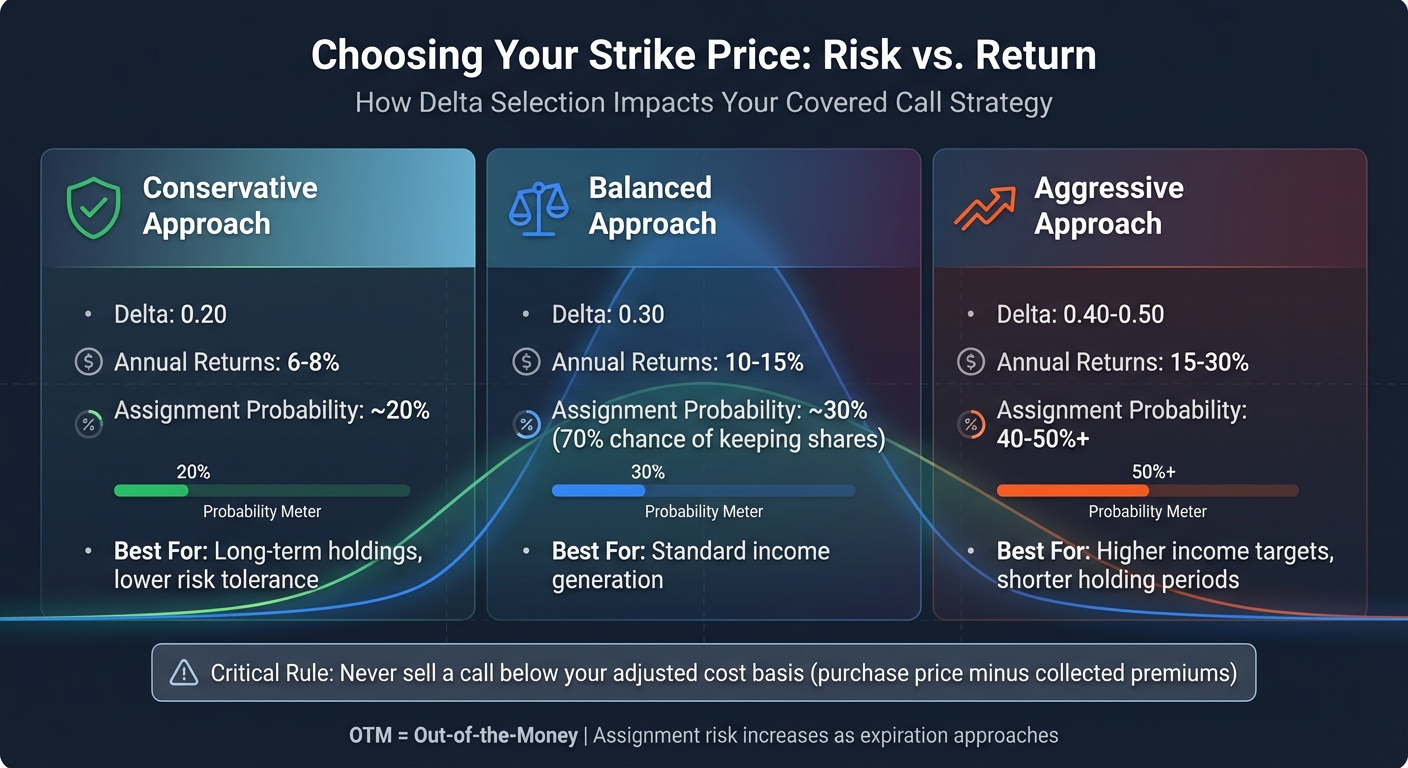
Covered Call Strike Price Comparison: Delta, Returns, and Assignment Risk
Fine-tuning your approach to covered calls involves more than just reducing early exercise risk. Choosing the right strike prices, expirations, and leveraging advanced tools can help protect your income strategy.
Select Appropriate Strike Prices and Expirations
Your strike price is the key factor in managing assignment risk. Out-of-the-money (OTM) strikes are usually the safest bet to avoid early exercise. For instance:
- A 0.30 delta strike provides about a 70% chance of keeping your shares, with annual returns in the range of 10–15%.
- For longer-term holdings, a 0.20 delta strike is more conservative, offering annual returns of 6–8% and around 20% assignment probability.
- More aggressive traders might opt for 0.40–0.50 delta strikes, which can target higher returns of 15–30% annually but come with a much higher assignment risk, roughly 40–50% or more.
When it comes to expiration dates, a 21–30 day window strikes a good balance by optimizing how time decay impacts covered calls while keeping assignment risk lower. Monthly expirations (30–45 days) are ideal for those seeking a steady income stream with less frequent management. On the other hand, weekly options (7–14 days) offer faster time decay but demand closer monitoring.
One critical rule: never sell a call below your adjusted cost basis (your purchase price minus collected premiums). Doing so guarantees a loss if you're assigned. As market conditions shift, continuously reevaluating your parameters ensures your strategy stays effective.
Use AI-Driven Analysis and Tools
After setting your strikes and expirations, AI-powered tools like ThetaEdge can help you manage and adjust your positions more effectively. These tools simplify portfolio tracking by monitoring time premium, dividend dates, and assignment probabilities, allowing for proactive risk management.
Maxim Khailo, Founder & CEO of ThetaEdge, explains the platform’s origins:
"Running the hedge fund, I created institutional tools that could analyze thousands of scenarios in real-time... ThetaEdge empowers [self-directed investors] to do it with the same tools the elite have always used."
ThetaEdge offers daily, AI-generated action plans that flag expiring positions, highlight new opportunities, and suggest trades. If a stock’s price approaches your strike, its Roll Assistant can evaluate strategies such as rolling up, down, or out, recommending the best option for net credit or debit.
Additionally, the platform’s Thetix AI allows you to ask straightforward questions like, “What’s my assignment risk this week?” or “Which positions should I roll?” It provides clear, data-backed answers through dynamic insight cards that adjust to market changes. With built-in tracking for portfolio Greeks across over 80 brokerages, ThetaEdge gives you a full view of your exposure and helps you address risks before they escalate.
For investors juggling multiple positions, these tools turn a traditionally reactive process into a proactive one. By identifying which positions need attention and suggesting optimal adjustments, they eliminate the need for manual calculations and streamline decision-making.
Conclusion
The decision to exercise early often hinges on financial motives such as capturing dividends, addressing liquidity needs, or mitigating the loss of time value. Understanding these factors is critical to protecting your covered call positions and ensuring a consistent income stream.
As expiration nears, the likelihood of assignment rises sharply. Options with 60–90 days to expiration typically carry minimal risk, but this risk escalates significantly during the final 0–3 days for in-the-money positions. Monitoring days to expiration (DTE) and ex-dividend dates can help you identify potential risks and adjust your approach accordingly.
Effective management is essential. Following the 50% rule - closing positions after achieving half their maximum profit - allows you to capture theta before risk peaks. For in-the-money options nearing expiration, rolling them to later dates within the 7–14 DTE window can help maintain control and even generate additional credit. When dealing with dividend-paying stocks, closing or rolling short calls 2–3 days before the ex-dividend date can prevent assignment, especially when time value drops below the dividend.
For those looking to streamline these efforts, ThetaEdge offers tools to simplify the process. Its AI-driven features, such as assignment probability forecasts, daily action plans, and the Roll Assistant, eliminate the need for manual tracking. The platform's Thetix AI even provides clear answers to questions like "What’s my assignment risk this week?", combining advanced analysis with user-friendly insights.
FAQs
How do I know if my covered call is at risk of early assignment?
If your covered call is deep in-the-money or a dividend date is near, there’s a chance of early assignment. Pay attention to signs like the stock price trading well above the strike price or sharp price jumps. Keeping an eye on these elements is crucial, particularly with American-style options, as they can be exercised at any time. Regular monitoring can help you stay ahead of potential early exercise risks.
Should I roll my call before the ex-dividend date or close it?
Deciding whether to roll or close your call before the ex-dividend date hinges on your overall strategy. Early exercise typically happens when the dividend is larger than the option's remaining time value. If your goal is to avoid early exercise and keep your premium income intact, you might want to roll or close the call. On the other hand, if collecting the dividend fits your plan, early exercise could work in your favor. Be sure to weigh factors like the dividend amount, the option's time value, and any transaction costs before making a move.
What happens to my taxes if my shares get called away early?
When shares are sold early because of a covered call, the premium you earned is typically treated as short-term capital gains. This applies in the year the option is either exercised or expires. The stock sale itself is another taxable event, where your cost basis is adjusted based on the premium received and the sale price of the shares. Whether your gains are taxed as short- or long-term depends on your holding period for the stock. For specifics, it's always a good idea to check with a tax professional.