

5 Mistakes to Avoid When Rolling Covered Calls
Practical rules to avoid costly covered-call roll mistakes: time rolls, include fees/slippage, avoid earnings windows, account for IV, and monitor Greeks.
Rolling covered calls can help you generate income, but it’s easy to make costly mistakes if you’re not careful. Here’s a quick guide to avoid the most common pitfalls:
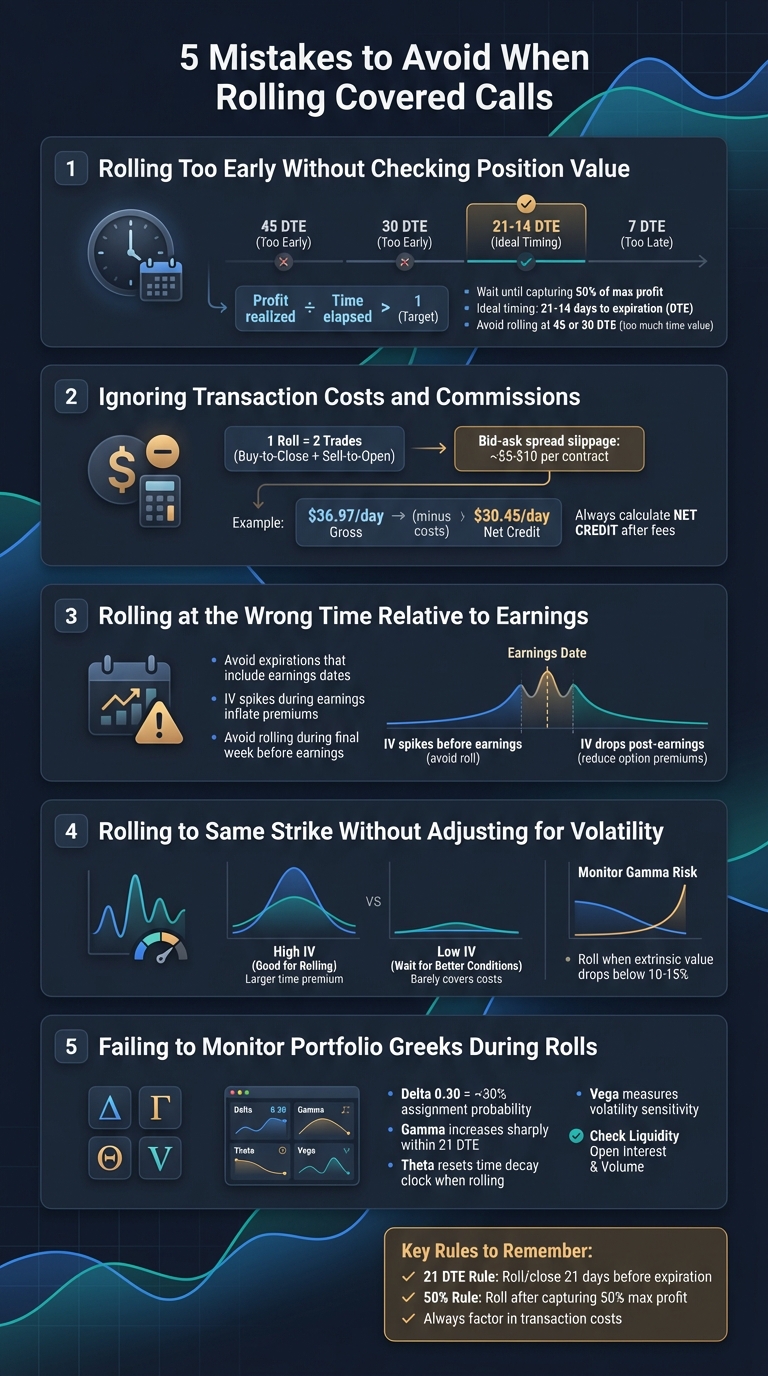
- Don’t roll too early: Wait until you’ve captured at least 50% of the profit or are within 21–14 days to expiration.
- Account for costs: Always factor in transaction fees and slippage to ensure the roll is profitable.
- Watch for earnings: Avoid rolling into expirations that coincide with earnings announcements, as volatility can lead to unfavorable outcomes.
- Adjust for volatility: Monitor implied volatility (IV) and avoid rolling to the same strike if IV levels are low.
- Track portfolio Greeks: Keep an eye on delta, gamma, and other Greeks to manage assignment risk and time decay effectively.
5 Critical Mistakes to Avoid When Rolling Covered Calls
1. Rolling Too Early Without Checking Position Value
Timing of the Roll
One common misstep traders make is rolling their calls too soon, effectively giving up the natural benefit of time decay. The issue? When you roll prematurely, you’re essentially buying back time value that would have eroded on its own if you had just waited a bit longer.
Experienced traders typically aim to roll after capturing 50% of the maximum profit on a short call. For instance, if you sold a call for $2.00 and its value has dropped to $1.00, you’ve reached that halfway mark. At this point, the pace of time decay slows, making it a sensible moment to reassess your strategy.
The ideal time to roll is generally between 21 and 14 days to expiration (DTE). Rolling earlier - such as at 45 or 30 DTE - usually doesn’t add up because the position still holds considerable time value, meaning you’re paying extra for no real advantage. On the other hand, waiting too long, say until 1-3 DTE, can expose you to wider bid-ask spreads, which can eat into your profits. This mid-range window strikes a balance, allowing you to capitalize on time decay without unnecessary costs.
A helpful way to decide if it’s time to roll is by checking if the profit realized divided by the time elapsed exceeds 1. This straightforward calculation can help you avoid jumping the gun and rolling before your position has truly delivered its value.
sbb-itb-a9ac3c2
2. Ignoring Transaction Costs and Commissions
The Role of Transaction Costs
Once you've nailed the timing for rolling your covered calls, it's time to focus on something equally important: transaction costs. Using an options strategy planner can help you visualize these multi-leg adjustments and their impact on your bottom line.
Every time you roll a covered call, you're making two trades - buy-to-close and sell-to-open - which doubles the commission fees you incur. If you roll frequently, these costs can eat into your returns.
"Brokers charge commissions per trade. If you roll 10 times, you pay 20 commissions." – Days to Expiry
But commissions aren't the only factor. The bid-ask spread can also take a bite out of your profits. When the price you execute deviates from the mid-price, especially in less liquid options, the slippage can add $5–$10 per contract. This quickly chips away at the premium you're trying to collect.
Consider this example: In December 2007, after paying a $10.50 commission, an investor's December 195 call generated $36.97 per day. However, rolling into a January 195 call dropped the daily yield to $30.45. The transaction costs made the roll unprofitable.
To avoid scenarios like this, always calculate your net credit after factoring in commissions and slippage. If the net credit is minimal or negative, it might make more sense to let your shares be called away and then start fresh. Using limit orders can help you control execution prices and reduce slippage, especially during the final days before expiration.
3. Rolling at the Wrong Time Relative to Earnings or Events
Watching for Earnings and Market Events
When managing covered calls, earnings announcements can complicate things. These events often cause implied volatility (IV) to spike, inflating option premiums. While this might seem like an opportunity, rolling a covered call into an expiration that includes an earnings date can backfire. If the stock price jumps significantly after the announcement, you could face tough choices: either roll again at a loss or accept assignment at a price far below the new market level.
"To avoid the unpredictable price movement of stocks during earnings announcements, many investors will avoid putting on covered call strategies where the short call expiration spans across the earnings date." – Gavin, Options Trading IQ
This highlights why timing around earnings requires a shift in focus - from capturing time decay to managing event-driven volatility.
Choosing the Right Roll Timing
Before rolling, always check the calendar for earnings dates. Using tools like Thetix for portfolio analysis can help you track these events in plain English. If your new expiration overlaps with an earnings event, be prepared for added risks. For those aiming to take advantage of higher premiums from elevated IV, rolling before the event can make sense, but it also increases exposure to volatility. To steer clear of gamma risk, avoid rolling during the final week leading up to earnings.
Managing Implied Volatility Changes
After an earnings event, IV typically drops, which reduces option premiums. This post-earnings IV decay can work in your favor if the stock price stabilizes, as premium decay benefits you. When considering a roll, compare current IV levels to historical averages. If IV is unusually low, it might be better to wait for better conditions or adjust the strike price instead of locking in a less favorable trade.
4. Rolling to the Same Strike Without Adjusting for Volatility
Adjustment for Implied Volatility
When rolling a covered call, it's not just about timing and fees - keeping an eye on market volatility is equally crucial to managing risk effectively.
Rolling to the same strike price, often called "rolling out", simply extends your position without changing your outlook on the stock's direction. However, implied volatility (IV) has a significant impact on whether this move is profitable. High IV typically results in a larger time premium, allowing for a net credit, whereas low IV might barely cover your costs.
"Market volatility plays a crucial role in determining whether rolling an option is a good idea. Many traders roll without considering shifts in implied volatility (IV), which can lead to unfavorable trade adjustments." – Gavin, Founder, Options Trading IQ
Before committing to a roll, take a moment to compare current IV levels to their historical averages. Elevated IV can present an opportunity to collect a worthwhile credit, making the roll more attractive. On the flip side, if IV has dropped - perhaps after an earnings report or a period of market calm - the premium you collect may not justify the move. In such low-volatility moments, it might be wiser to hold off until conditions improve or adjust your strike price rather than locking in a less favorable roll.
Portfolio Greeks Awareness
As your option nears expiration, gamma risk increases, meaning even small changes in the stock price can cause significant shifts in your option's delta. For example, a short call with a delta of 0.30 can quickly jump to 0.55 or higher if the stock nears your strike price. Rolling to the same strike without accounting for these changes can inadvertently extend a position that carries a higher risk of assignment.
To manage this, keep an eye on delta and extrinsic value. If the extrinsic value drops below 10–15% of the option's price, it’s a signal to roll sooner rather than later to avoid heightened gamma risk. This practice ensures you're not caught off guard by rapid shifts in risk as expiration looms.
5. Failing to Monitor Portfolio Greeks During Rolls
Understanding Portfolio Greeks
When rolling options, keeping an eye on your portfolio Greeks is essential. These metrics - Delta, Gamma, Theta, and Vega - help you gauge how your position reacts to price changes, time decay, volatility shifts, and assignment risk. Think of them as your trading dashboard, offering critical insights into potential risks.
"The Greeks act like dashboard warning lights, helping traders understand how different market conditions affect their options positions." – Investopedia
For example, a delta of 0.30 suggests there’s about a 30% chance of assignment. When you roll, ensure the new strike aligns with your risk tolerance.
Gamma becomes especially important within 21 days of expiration, as it increases sharply. This can cause delta to change rapidly, elevating the likelihood of early assignment. What might seem like a low-risk position at first can become much riskier as expiration nears.
Theta, or time decay, is another critical factor. Rolling "out" to a later expiration resets the time decay clock and allows you to collect additional premium. Meanwhile, Vega measures how sensitive your position is to changes in implied volatility. Ignoring Vega could lead to costly mistakes, such as buying back calls at a higher price than the original credit received.
Managing Assignment Risk and Liquidity
Beyond the Greeks, monitoring extrinsic value is key to managing assignment risk. As extrinsic value approaches zero, the risk of early assignment increases. Before rolling into a new strike, check liquidity by reviewing open interest and daily volume. Low liquidity can result in slippage, which may eat into your credit and complicate adjustments.
Failing to account for these factors can derail your rolling strategy, exposing you to unexpected costs and risks that could have been avoided with proper monitoring.
How ThetaEdge Helps Avoid These Mistakes
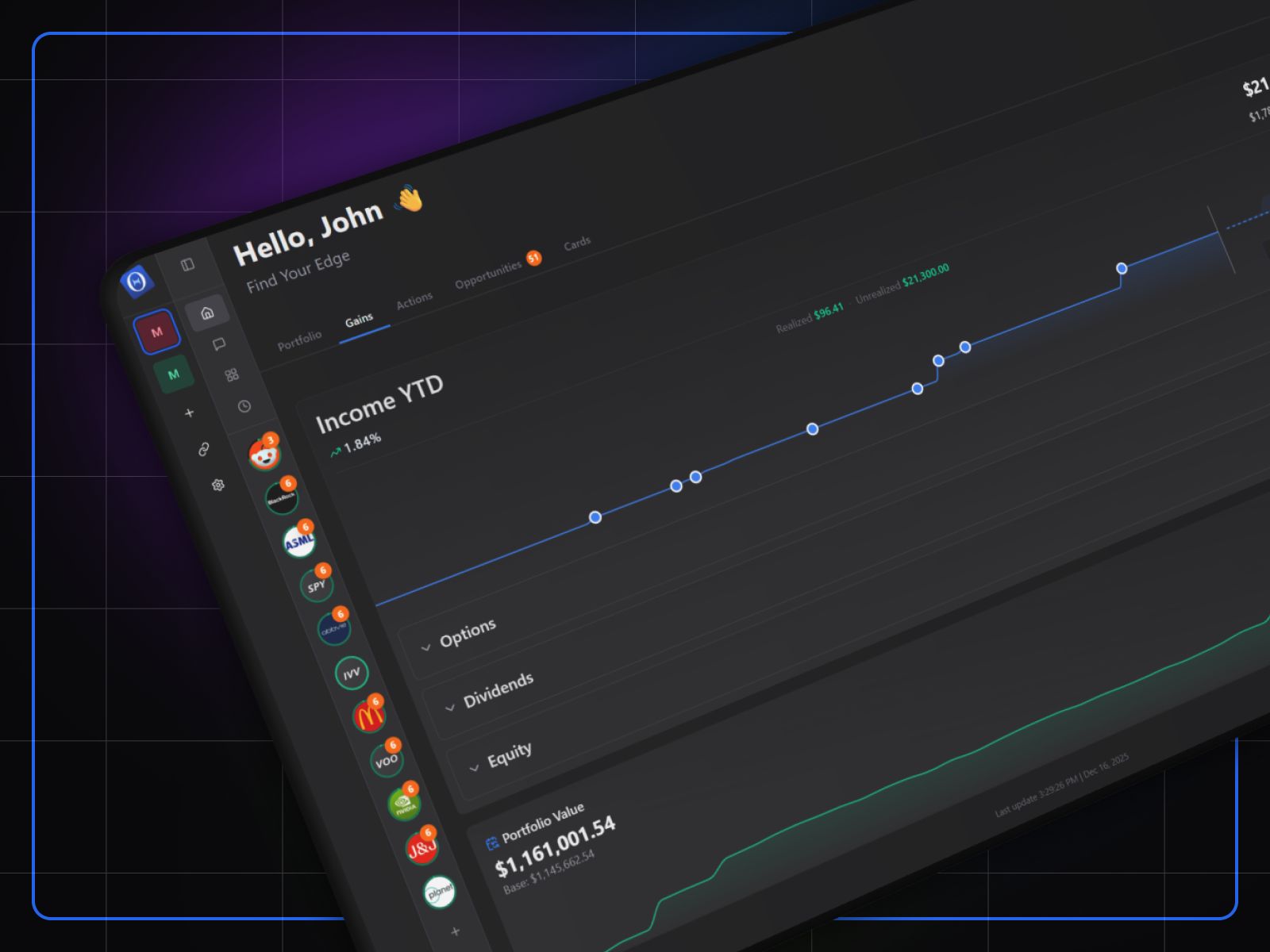
Rolling covered calls demands constant vigilance and precise timing - tasks that can be tricky to handle manually, especially when juggling multiple positions. ThetaEdge steps in with professional-grade tools designed to tackle these challenges effectively.
To address the need for perfect timing, ThetaEdge offers actionable insights through its Roll Decision Analyzer. This tool evaluates assignment probabilities and pinpoints the best timing across different DTE (days to expiration) stages, helping you sidestep the pitfalls of rolling too early or too late. You can also set automated profit alerts that notify you when a short call hits your specified profit target - like the 50%-80% profit rule - so you never miss the ideal moment to exit. The platform even highlights critical milestones, such as the "Critical Point" at 21 DTE, when gamma risk increases significantly, and the "Close-out Week" at 7 DTE, when rolling often becomes less viable due to wider spreads and slippage.
ThetaEdge also ensures that transaction costs are factored into every roll scenario through its credit/debit analysis. By tracking your effective cost basis across multiple rolling cycles, it prevents the common mistake of losing sight of true profitability. The platform allows you to compare the financial benefits of rolling versus assignment, helping you determine whether the cost of rolling justifies the potential gains.
Managing assignment risk is another key area where ThetaEdge excels. Its real-time Greek monitoring keeps you ahead of the curve, using Vega tracking to alert you when high implied volatility could inflate the value of your sold calls. To top it off, ThetaEdge includes an AI-powered assistant for even greater precision. The Thetix AI assistant lets you ask straightforward questions like, "What is my assignment risk if I roll this call up and out?" and provides instant, data-driven answers through actionable cards. Additionally, daily AI-generated action plans flag expiring positions and suggest timely trades, ensuring you never miss critical roll opportunities.
"Running the hedge fund, I created institutional tools that could analyze thousands of scenarios in real-time, set sophisticated alerts, and manage complex strategies with precision timing. More people want to make their own destiny, and ThetaEdge empowers them to do it with the same tools the elite have always used." – Maxim Khailo, Founder & CEO, ThetaEdge
Conclusion
Rolling covered calls demands a well-thought-out approach. Avoiding common errors - like rolling too early, overlooking transaction costs, ignoring key events, failing to adjust for volatility, and neglecting portfolio Greeks - can make the difference between a strategy that thrives and one that drains your resources. Careful planning and an awareness of costs relative to premiums collected are critical to staying on track.
To recap, sticking to disciplined execution is non-negotiable. A rules-based approach, rather than one driven by emotion, can help maintain consistency. For instance, many seasoned traders follow the 21 DTE rule - rolling or closing positions 21 days before expiration to minimize gamma risk and reduce the chance of assignment. Others rely on the 50% rule, which involves rolling or closing a position once the short call has captured half of its maximum profit. Whatever framework you choose, let data guide your actions and stay committed to your strategy.
Platforms like ThetaEdge offer the tools needed for precision. With professional-grade analytics and real-time monitoring, you can track Greeks, calculate net credits and debits, and receive alerts for optimal timing. The platform’s AI-driven insights and daily action plans help you navigate the complexities of rolling covered calls, ensuring you avoid costly mistakes and seize opportunities when they arise.
FAQs
When should I roll versus let my shares get assigned?
When options are approaching expiration, and there's a chance your shares might be called away, it’s worth thinking about rolling your covered calls. Another good time to adjust is when market conditions shift, making it more advantageous to tweak your position.
Some key indicators to watch include a delta between 0.55 and 0.65 or the time value falling below 10–15% of the option’s price. These signs suggest the option is nearing a point where action may be needed.
However, if the stock hasn’t moved significantly or is close to your desired exit price, it might make more sense to let the shares get assigned rather than rolling the position.
How do I estimate assignment risk before I roll a covered call?
When evaluating assignment risk, the option's delta is a key metric. Delta represents the approximate probability of the option expiring in-the-money (ITM). For example, an option with a delta of 0.30 indicates a 30% chance of expiring ITM. Other factors also play a role, such as implied volatility, time left until expiration, and any upcoming dividend dates. Many traders prefer targeting a delta range of 0.15–0.35 when rolling options, as this range tends to strike a balance between generating income and managing the likelihood of assignment.
How do I choose a new strike and expiration when implied volatility changes?
When implied volatility changes, it's important to reassess your strike price and expiration based on current market trends and your personal risk and reward preferences. Many traders choose to roll their options when the time value falls below 10–15% or when the delta increases to a range of 0.55–0.65. A popular approach involves selecting an expiration date 30–45 days away with strikes that are 1–2 levels out-of-the-money (OTM). This method aims to strike a balance between generating income and managing risk effectively.