

How to Evaluate Covered Call Risks
Measure assignment odds, weigh premium vs upside, compute breakeven, and manage portfolio Greeks to control covered call risk.
Covered calls let you earn income by selling call options on stocks you already own. You collect a premium upfront, but in return, you agree to sell your shares at a set price if the option is exercised. This strategy offers income but limits your upside potential and exposes you to risks if the stock price drops significantly.
Here’s how to assess covered call risks effectively:
- Assignment Risk: Use the option's delta to gauge the probability of your shares being called away. Lower deltas (0.15–0.30) reduce assignment risk but yield smaller premiums.
- Premium vs. Upside: Higher premiums come with greater assignment risk and less room for stock appreciation. Strike prices closer to the stock price offer more income but limit potential gains.
- Downside Protection: The premium lowers your breakeven price, providing some cushion if the stock falls. However, it won't protect you from major losses.
- Portfolio Impact: Evaluate how covered calls fit into your overall portfolio, considering metrics like delta, theta, and vega to manage risk and income balance.
- Market Conditions: High volatility increases premiums but raises risks. Monitor factors like ex-dividend dates and market trends to avoid surprises.
Tools like ThetaEdge can simplify this process by analyzing assignment probabilities, breakeven points, and portfolio risks in real time. Covered calls can be a reliable income strategy when you carefully weigh trade-offs and align them with your financial goals.
Step 1: Understanding Assignment Probability

Covered Call Delta Ranges: Risk vs Premium Trade-offs
Assignment happens when the buyer of a call option exercises their right, requiring you to sell your shares at the strike price. Before selling a call, it's crucial to estimate how likely this is to occur.
The delta of an option provides a quick way to gauge assignment risk. Delta reflects the approximate percentage chance that the option will end up in-the-money (ITM) at expiration. For example, a call with a delta of 0.22 suggests a 22% chance of finishing ITM and about a 78% chance of expiring worthless, meaning you keep your shares.
"Many traders look at delta as an approximate percentage chance that an option will be ITM at expiration. Although it's not a perfect science, an options delta calculation can provide a pretty close estimate." - Charles Schwab
Using Delta to Manage Assignment Risk
For call options, delta ranges from 0 to 1.0. Here's how it works:
- At-the-money (ATM) calls have a delta near 0.50, making assignment roughly a 50/50 proposition.
- Out-of-the-money (OTM) calls have deltas below 0.50, indicating lower assignment risk.
- In-the-money (ITM) calls carry deltas above 0.50, signaling a higher likelihood of assignment.
If you want to reduce assignment risk, consider selling calls with higher strike prices and deltas between 0.15 and 0.30. While this approach lowers the premium you collect, it increases the odds of keeping your shares. On the other hand, calls with deltas of 0.60 or higher bring in more premium but significantly raise the chance of your shares being called away.
Delta is dynamic - it shifts as the stock price changes and expiration approaches. If the delta of an OTM call you sold starts creeping toward 0.50, it’s a sign that assignment risk is increasing, and you may need to adjust your strategy. Monitoring ITM risk as expiration nears is another critical step.
Evaluating ITM Risk Near Expiration
As expiration approaches, tracking whether your call is ITM becomes even more important. Options with low intrinsic vs extrinsic value (specifically low time value) are more likely to be exercised, increasing assignment risk.
Certain scenarios, like ex-dividend dates, heighten this risk. If your short call is ITM and the stock is about to pay a dividend, assignment probability can soar to 80% or higher as buyers exercise early to capture the dividend. Similarly, corporate actions like mergers or special dividends can lead to near-certain assignment.
| Scenario | Timing/Condition | Early Assignment Probability |
|---|---|---|
| Ex-Dividend Date | ITM short call before ex-dividend | HIGH (80%+) |
| Deep ITM Call | Call is $3+ above market price | HIGH (especially near expiration) |
| Low DTE (1-3 days) | Option is ITM with minimal time value | MEDIUM to HIGH |
| High DTE (30+ days) | Any delta | LOW (<1%) |
| Corporate Action | Merger or acquisition announced | VERY HIGH (often 100%) |
For example, a 7-day call with a delta of 0.70 might carry a 15% chance of early assignment, while a 30-day call at any delta generally has less than a 1% chance due to the remaining time value. Always approach covered call positions with the assumption that assignment could happen, rather than relying on the odds that it won’t.
sbb-itb-a9ac3c2
Step 2: Evaluating Premium Trade-offs
Covered calls require you to weigh two key factors: maximizing upfront premium or leaving room for potential stock gains. Strikes closer to the current stock price (higher delta) offer larger premiums but cap your upside and increase the chance of assignment. On the other hand, strikes further from the stock price (lower delta) provide smaller premiums but allow for more stock appreciation.
Balancing Premiums with Upside Limits
Choosing the right strike price is all about managing the balance between income and growth potential. Here's how different strike prices can impact your returns:
- A 30-delta call can generate a 10–15% annual return, with a 70% chance of keeping your shares.
- A 40-delta call boosts the return to 15–20% but raises the likelihood of assignment to 40%.
- Strikes at 50-delta or higher might yield over 20–30%, though the assignment risk climbs to 50%.
Let’s break this down with an example. Imagine you own 100 AMD shares purchased at $150 each, and the stock is now trading at $155. You sell a 30-delta call with a $160 strike price and 30 days until expiration, collecting $3.50 per share in premium. This gives you a 70% chance of holding onto your shares. If assigned, you'd earn a total profit of $1,350 - $10 per share in capital gains plus the premium.
One critical rule: never sell calls below your adjusted cost basis (your purchase price minus any premiums collected). Doing so locks in a loss if the shares are assigned. Market trends also matter. In bullish conditions, lower delta strikes (20–25 range) allow for more upside capture. For neutral markets, higher delta strikes are better for generating income. With volatile stocks like NVDA or TSLA, wider strikes in the 20–25 delta range can help reduce the risk of premature assignment due to sharp price swings.
Using Profit-Loss Diagrams
Profit-loss diagrams are excellent tools for visualizing the trade-offs of a covered call. They illustrate how profits increase with the stock price but level off once the strike price is reached - your maximum gain. The premium you collect raises your breakeven point, which helps cushion potential losses if the stock price drops. These diagrams are a practical way to confirm that your chosen balance between premium and upside aligns with your overall market outlook.
Step 3: Calculating Downside Exposure and Breakeven Points
Covered calls can provide a steady income stream, but they don't shield you from losses if the stock price drops. The premium you collect acts as a buffer, but it's important to figure out where that buffer ends. This step ties into the covered call strategy risk-reward balance we touched on earlier.
Calculating Your Breakeven Price
To determine your breakeven price, subtract the premium you received from the stock's purchase price. For instance, if you bought a stock at $50.00 and earned a $2.50 premium, your breakeven price would be $47.50, giving you a 5% cushion. To calculate this percentage, use the formula: (Premium Received ÷ Stock Purchase Price) × 100. In this example, ($2.50 ÷ $50.00) × 100 = 5%.
If you’re not comfortable with the idea of a 5% decline, the premium might not be worth the risk. For reference, premiums on blue-chip stocks typically offer 1–3% monthly downside protection, according to 2023 data from the CBOE.
Once you’ve identified your breakeven price, the next step is to assess how far the stock could drop before hitting this threshold.
Measuring Downside Risk
Understanding your potential loss in a worst-case scenario is just as critical. Beyond your breakeven price, calculate the maximum loss as the stock's full decline from your purchase price to zero. Use this formula: (Stock Purchase Price − Premium Received) × Number of Shares. For example, with 100 shares purchased at $50.00 and a $2.50 premium, your maximum loss would be ($50.00 − $2.50) × 100 = $4,750.
The risk grows with larger positions. If you hold 500 shares at the same price and premium, your potential loss increases to $23,750. To manage risk, many investors limit individual positions to 1–5% of their total portfolio. These calculations help ensure your covered call strategy aligns with your overall risk tolerance.
Additionally, compare your breakeven price to key technical levels, such as the 200-day moving average. If your breakeven sits below a strong support level, it provides an extra layer of confidence in your margin of safety.
Step 4: Analyzing Portfolio Impact
Once you've evaluated assignment probabilities and premium trade-offs, it's time to step back and see how these covered call positions fit into your overall portfolio. While a single covered call might seem straightforward, the real picture emerges when you assess all your positions together. This broader view helps you understand the cumulative risks and rewards.
Using Portfolio Greeks to Measure Risk
Portfolio Greeks are a powerful tool to gauge the overall risk in your portfolio. These metrics combine the risks of individual positions into a cohesive picture:
- Portfolio Delta shows your net directional exposure. For instance, if your portfolio delta is +150 while writing covered calls across multiple stocks, you're still significantly exposed to market downturns. It's important to monitor this number daily, as it shifts with price movements.
- Portfolio Theta measures how much income you generate daily from time decay. Covered call strategies often aim for positive theta, allowing you to collect income as time passes.
- Portfolio Gamma reveals a hidden challenge for premium sellers. Covered calls inherently carry negative gamma. This means that when the market drops, your risk increases, as negative gamma amplifies your exposure to falling prices.
- Portfolio Vega tracks your sensitivity to changes in implied volatility. Covered calls have negative vega, so a sudden spike in volatility can wipe out weeks of theta gains in a single trading session.
To put this in perspective, the S&P 500 covered call index has historically shown about two-thirds the volatility of a traditional buy-and-hold strategy while maintaining comparable returns. Understanding how these Greeks interact is key to achieving that lower volatility profile.
But risk isn’t just about the Greeks - it’s also shaped by market conditions.
Accounting for Volatility and Market Conditions
Beyond the Greeks, implied volatility and overall market stress play a crucial role in shaping your risk. Implied volatility (IV) affects both the premiums you collect and the expected price swings of your underlying assets. During high-IV periods, systematic covered call writing can generate annualized returns near 20% on META and 23% on TSLA. However, these higher premiums come with strings attached: increased assignment risk and the potential for sharper stock declines.
Another factor to keep an eye on is correlation. In times of market stress, correlations between stocks often spike. For example, covered calls on Apple, Microsoft, and Amazon - normally seen as diversified - can start behaving like a single concentrated position if the tech sector experiences a sell-off. Correlations can approach 1.0 during turbulent periods, amplifying your portfolio's risk.
Finally, be mindful of how you stagger your options' expiration dates. If multiple covered calls expire in the same week, you concentrate your gamma risk. This creates a scenario where even small price movements can lead to outsized swings in your portfolio, making timing a critical consideration.
Step 5: Using ThetaEdge for Risk Evaluation
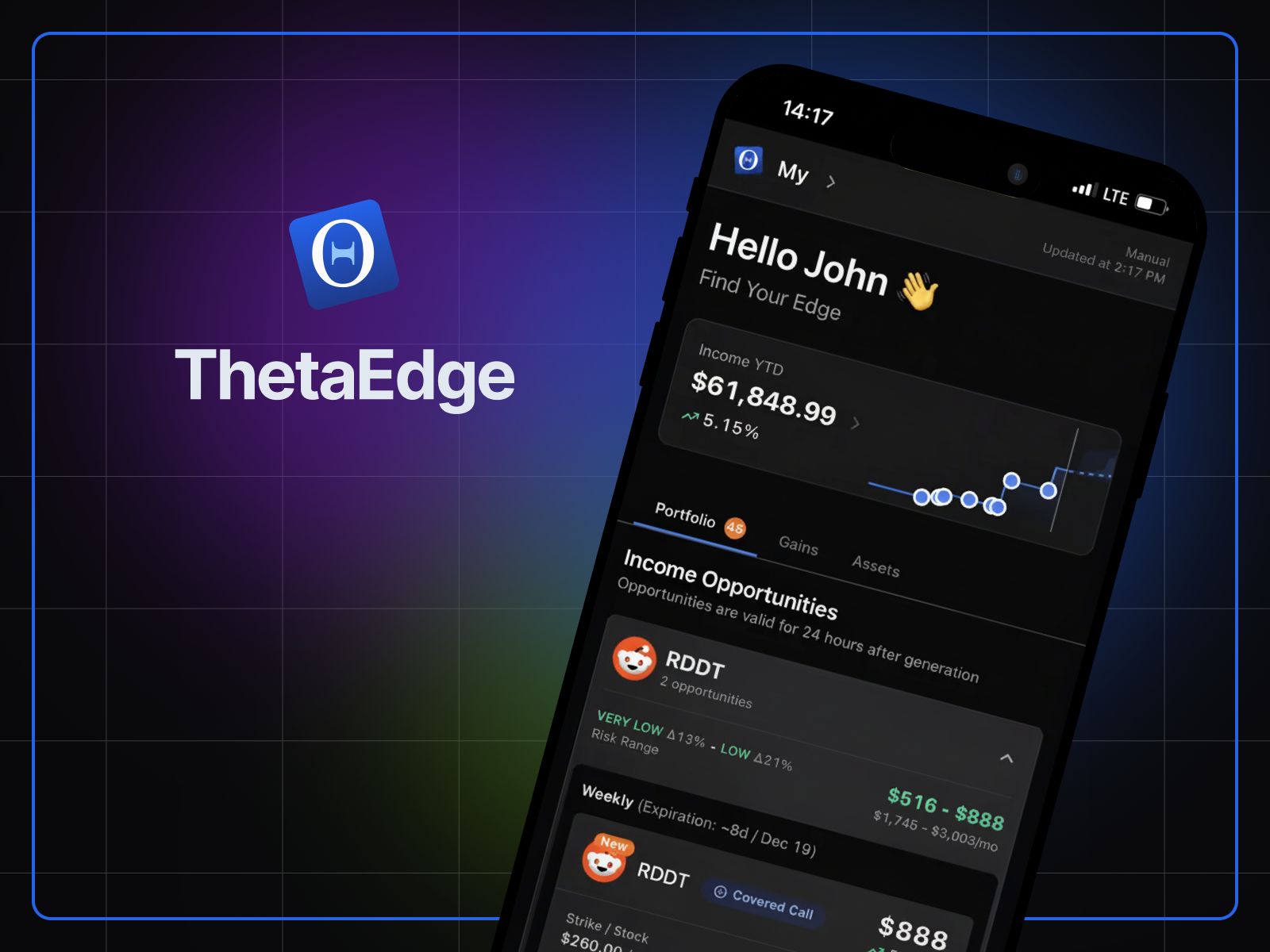 After conducting manual risk assessments, you might find yourself wishing for a quicker way to bring all the data together. That’s where ThetaEdge steps in - a platform designed to streamline risk evaluation for covered calls.
How ThetaEdge Analyzes Risk and Trade-Offs
ThetaEdge connects to over 80 brokerages using read-only access, analyzing your actual portfolio without requiring tedious manual data entry. It calculates essential risk metrics like delta-based assignment probability, breakeven points, profit-loss scenarios, and annualized yield - all while saving you hours of manual work.
What makes ThetaEdge stand out is its portfolio-aware analysis. Instead of treating each covered call as a standalone decision, it evaluates how a specific trade impacts your overall portfolio. For example, if your portfolio already has high exposure to volatility (short vega), ThetaEdge will flag if adding another covered call might amplify this risk. This feature helps you avoid unintentionally concentrating exposure across multiple trades.
The platform also provides a clear breakdown of trade-offs. When comparing strike prices, you can see exactly what you’re gaining and giving up. For instance, a $105 call on a $100 stock might offer a $2.50 premium but cap your upside at 5%, whereas a $110 call provides a $1.00 premium while allowing for a 10% upside. All key details - strike price, expiration, premium, assignment probability, and breakeven - are displayed in one view, making it easy to assess your options. From there, the platform transitions seamlessly into AI-powered evaluation.
Making Complex Analysis Simple with AI
ThetaEdge’s AI takes the heavy lifting out of intricate calculations. Its Thetix AI assistant answers your questions in plain English, eliminating the need for manual Black-Scholes calculations or building profit-loss diagrams. You can ask, “What happens if this stock rallies 10%?” and instantly get accurate answers based on live market data and your portfolio. The platform also tracks your positions in real time, sending alerts when thresholds like assignment probability or profit targets - such as a 35% maximum premium benchmark - are reached.
"I no longer had to shift my investments or learn complex tools. I keep my accounts where they are, and everything's explained in plain language." - Sarah C., Marketing Director
While ThetaEdge doesn’t execute trades or offer investment advice, it ranks pre-evaluated opportunities based on criteria you choose, such as risk-adjusted return, theta decay, or assignment probability. By automating the calculations and framing risk consistently across all opportunities, ThetaEdge allows you to focus on making strategic decisions instead of getting bogged down in spreadsheets.
Conclusion
Understanding the risks of covered calls means weighing the trade-offs carefully. By selling a covered call, you trade unlimited upside potential for immediate premium income and some level of downside protection. The key question is whether this trade aligns with your market outlook and income goals.
The five-step framework outlined in this guide helps you evaluate each component systematically, while tools like ThetaEdge offer a streamlined way to incorporate portfolio-focused analysis and real-time risk metrics.
One common pitfall is focusing too much on the premium income without considering opportunity costs. For instance, a $2.50 premium might seem appealing, but if it caps your potential upside at 5% while the stock has room to gain 15%, the trade-off becomes less attractive. Another mistake is neglecting to adjust your risk metrics as market conditions evolve, which could leave you exposed to unexpected risks. Regularly updating these metrics ensures your strategy stays aligned with your goals and the current market environment.
Systematic risk assessment transforms covered calls from a speculative gamble into a well-thought-out income strategy. Historical data supports this: since 1986, covered call strategies have achieved about two-thirds the volatility of traditional buy-and-hold approaches while delivering comparable returns. For example, the S&P 500 covered call index has produced an annualized yield of 9.9%. These results highlight that, when approached with care and a clear understanding of the risks, covered calls can be a reliable way to generate income - provided you evaluate each position thoughtfully instead of simply chasing premiums.
Tools like ThetaEdge simplify this process by integrating real-time risk metrics and portfolio-aware analysis, making it easier to manage and refine your strategy.
FAQs
When should I roll a covered call to reduce assignment risk?
When your covered call approaches expiration - usually within 21 to 14 days - or the stock price has climbed significantly, it might be time to consider rolling the position. Rolling can also be useful in times of heightened market volatility or ahead of earnings announcements, where price swings can be more unpredictable.
A good rule of thumb is to aim for capturing at least 50% of the premium before deciding to roll. This approach strikes a balance between managing theta decay (the loss of time value in the option) and reducing the likelihood of an unexpected assignment. By rolling strategically, you can extend the trade while maintaining control over your shares.
How do I pick a strike price that balances premium and upside?
When deciding how to balance premium income with potential stock gains, delta can be a helpful indicator. A delta in the range of 0.30 to 0.40 typically strikes a balance between collecting premiums and keeping assignment risk under control.
Choosing an out-of-the-money strike gives your stock more room to rise, but the trade-off is smaller premiums. On the other hand, in-the-money strikes bring in higher premiums but come with a greater chance of your shares being called away. Whichever you choose, make sure the strike price plus the premium is higher than your cost basis - this ensures you won't end up with a loss.
How can multiple covered calls change my portfolio’s risk?
Writing multiple covered calls can help spread out your portfolio's risks. By staggering expiration dates and diversifying your exposure, you can better manage the chances of your shares being assigned. This approach also reduces the risk of being too concentrated in one position, giving you more control over potential losses.
Paying attention to options Greeks, particularly Delta and Theta, across all your positions can reveal how much risk you're carrying overall. Delta shows the likelihood of assignment, while Theta highlights how time decay is affecting your income. Keeping an eye on these metrics helps you make smarter decisions.
If the market moves against you, strategies like rolling your options to a later date or adjusting strike prices can help. These adjustments allow you to maintain a balance between generating income and protecting against downside risks, especially when you actively manage your positions.