

What Are Cash-Secured Puts?
Sell cash-secured puts to collect premium, set a buy price for shares, and manage assignment and downside risk with strikes and rolling.
A cash-secured put is an options strategy where you sell a put option and reserve enough cash to buy 100 shares of the stock at the strike price if assigned. It serves two purposes: earning income from the premium collected and potentially buying stocks at a lower price.
Here’s the key idea:
- You collect a premium upfront, which is yours to keep regardless of the outcome.
- If the stock price stays above the strike price, the option expires worthless, and you keep the premium.
- If the stock price drops below the strike price, you’re obligated to buy the shares, but the premium reduces your effective purchase price.
This strategy works best for investors willing to own the stock long-term and comfortable reserving cash to cover the purchase. It’s a way to generate income or acquire shares at a discount, but it comes with risks, such as potential losses if the stock price falls sharply.
Example:
- Stock price: $55
- Strike price: $50
- Premium: $2.30
-
Reserved cash: $5,000
If assigned, your effective cost per share is $47.70 ($50 - $2.30). If the stock stays above $50, you keep the $230 premium without buying the stock.
How Cash-Secured Puts Work
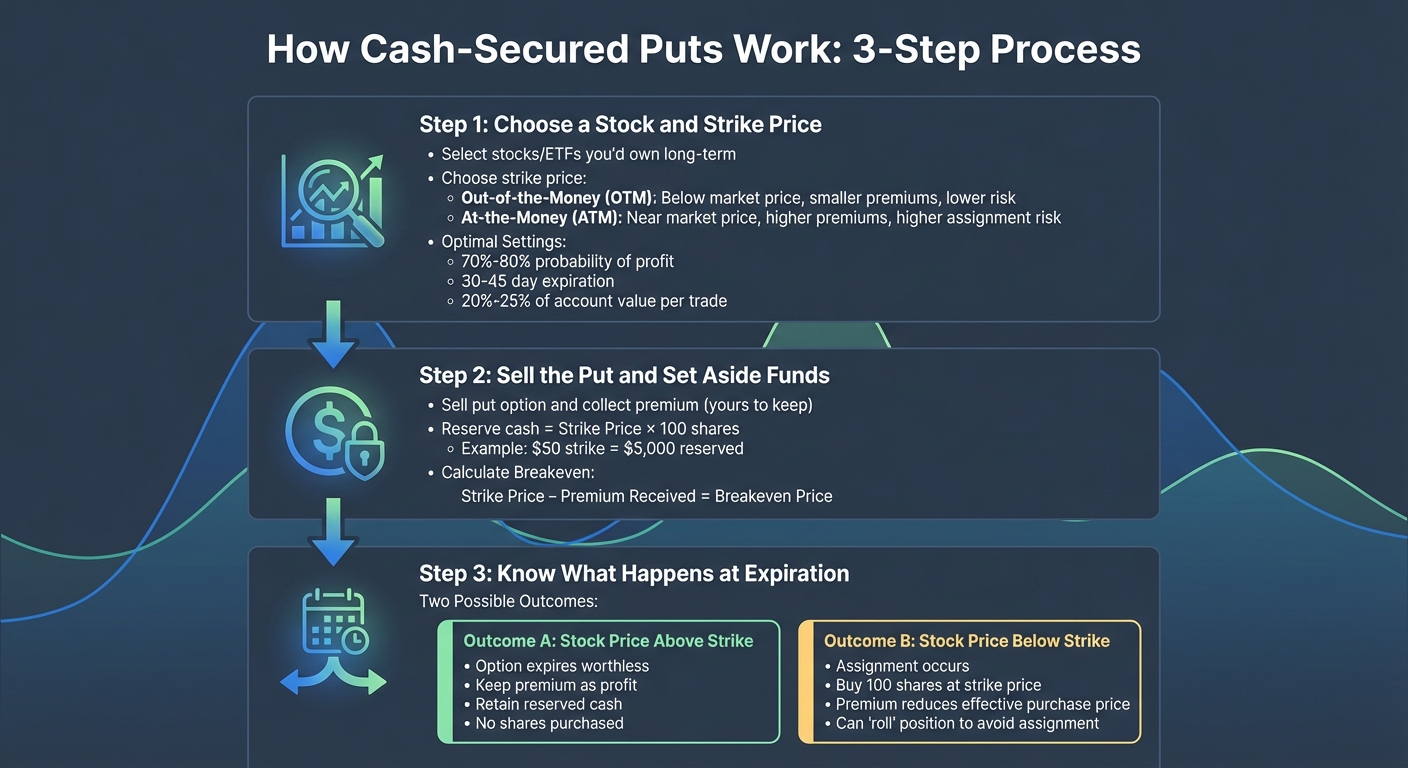
How Cash-Secured Puts Work: 3-Step Process and Outcomes
Executing a cash-secured put involves three main steps that help you manage risk and aim for better results.
Step 1: Choose a Stock and Strike Price
Start by picking stocks or ETFs that you’d be comfortable owning for the long term. Avoid the temptation to sell puts just because they offer high premiums - those premiums often indicate higher risk or potential issues with the underlying stock.
The strike price you select determines your potential purchase price and the likelihood of assignment. Out-of-the-money (OTM) strikes, set below the current market price, offer smaller premiums but provide a buffer against price declines. On the other hand, at-the-money (ATM) strikes, which are closer to the current market price, yield higher premiums but come with a greater chance of assignment and higher downside risk.
For a balanced approach, aim for a 70%-80% probability of profit. Opt for expirations in the 30-45 day range to take advantage of faster time decay, and limit each trade to 20%-25% of your account’s value.
Once you’ve made these decisions, move on to selling the put and setting aside funds.
Step 2: Sell the Put and Set Aside Funds
After selecting your stock and strike price, sell the put option and reserve enough cash to buy 100 shares at the strike price. The premium you collect is yours to keep, no matter what happens next.
For example, selling a put with a $50 strike price requires you to reserve $5,000 per contract. Your broker will hold this amount as collateral until the option expires or you close the position.
Before placing the trade, calculate your breakeven price using this formula:
Strike Price – Premium Received = Breakeven Price
This helps you understand your effective purchase price if you’re assigned.
Now, let’s look at how expiration plays out.
Step 3: Know What Happens at Expiration
At expiration, one of two outcomes will occur:
- If the stock price stays above your strike price: The option expires worthless. You keep the premium as profit and retain your reserved cash, with no shares purchased.
- If the stock price falls below your strike price: You’ll be assigned, meaning you must buy 100 shares at the strike price using your reserved funds. The premium you collected offsets your effective purchase price.
While assignment usually happens at expiration, it can occur earlier if the put becomes deep in-the-money with little time value left.
If the stock price drops and you’d rather avoid assignment, you can "roll" the position. This involves buying back the current put and selling a new one with a later expiration or a lower strike price. This strategy gives you flexibility to adjust as market conditions change.
sbb-itb-a9ac3c2
Benefits and Risks of Cash-Secured Puts
Now that we've explored how cash-secured puts operate, it's important to weigh their advantages against their potential downsides. Like any investment strategy, they come with trade-offs. By understanding these, you can determine whether this approach aligns with your financial goals. Using AI-powered portfolio analysis can help you visualize how these trades impact your overall strategy.
Main Benefits
One of the standout perks of cash-secured puts is the immediate premium income. This upfront cash flow adds to your portfolio, regardless of whether the option is exercised, making it a useful tool even in stagnant markets. If you're assigned the shares, you effectively purchase them at a discount. Your net cost becomes the strike price minus the premium you received.
As Andy, author of The Option Premium, aptly states:
"The premium is your payment for patience."
Another advantage is time decay. As the option nears expiration, its value naturally declines, increasing the likelihood that you'll keep the full premium.
Compared to traditional limit orders, cash-secured puts offer an edge. With a limit order, if the stock never hits your target price, the order simply expires. But with a cash-secured put, you still pocket the premium, regardless of the stock's movement. You can also use portfolio intelligence tools to analyze these opportunities across your holdings.
However, these benefits don't come without risks.
Main Risks
The most notable risk is downside exposure. If the stock's price drops significantly, you're still obligated to buy it at the strike price. In the worst-case scenario - if the stock's value plummets to zero - you could face a substantial loss equal to the strike price multiplied by 100, minus the premium earned.
Another limitation is the cap on profits. If the stock soars, your gains are confined to the premium you initially received.
Additionally, this strategy requires setting aside a large amount of cash to cover the potential purchase of 100 shares at the strike price. This can reduce your ability to seize other investment opportunities, particularly during market downturns.
Benefits vs. Risks Comparison
The table below provides a quick snapshot of the key trade-offs.
| Aspect | Benefit | Risk |
|---|---|---|
| Income | Immediate premium income, regardless of the outcome | Profit is limited to the premium received |
| Stock Purchase | Acquire shares at a discount (Strike - Premium) | Cash is tied up, reducing flexibility in volatile markets |
| Market Movement | Time decay works in your favor as expiration nears | Missed opportunity if the stock rallies sharply |
| Capital | Reserved cash may earn interest while held | Locked-up cash limits availability for other investments |
Cash-Secured Put Example
Sample Trade Walkthrough
Let’s break down a hypothetical trade to better understand the mechanics, calculate risk for cash-secured puts, and see the benefits of the strategy.
Imagine a stock trading at $100, but you’re aiming to buy it at a lower price. You sell one cash-secured put with a $90 strike price, expiring in 30 days. For this, you collect a $500 premium and set aside $9,000 to cover the purchase of 100 shares at $90. This setup gives you a breakeven price of $85 per share.
Here’s how different outcomes might play out at expiration:
If the stock rises to $105:
The put option expires worthless, as no one would sell shares to you at $90 when the stock is trading at $105. You keep the full $500 premium, earning a 5.6% return on the $9,000 collateral. Once the contract expires, your $9,000 is freed up for other opportunities.
If the stock stays at $90 or slightly above:
Again, the option expires worthless. You collect the $500 premium without acquiring any shares. This leaves you with the flexibility to sell another put or explore other strategies if you’re still interested in the stock.
If the stock drops to $80:
In this case, you get assigned and must purchase 100 shares at the $90 strike price, using the $9,000 you set aside. With the $500 premium factored in, your effective cost per share becomes $85. However, since the stock is now worth $80, you face an unrealized loss of $500 on your position.
If the stock plunges to $50:
Here, you’re obligated to buy 100 shares at $90, costing you $9,000. After factoring in the $500 premium, your effective cost basis is $85 per share. At a market value of $50 per share, your 100 shares are worth just $5,000, leaving you with an unrealized loss of $3,500. While the $500 premium softens the blow slightly, it doesn’t fully offset the steep drop. The worst-case scenario? If the stock’s value falls to zero, your maximum loss would be $8,500.
This example highlights the balance between potential income and the risks of holding the obligation to buy shares, especially in a falling market.
Tools for Analyzing Cash-Secured Puts
Evaluating cash-secured puts manually means juggling strike prices, expirations, and key probability metrics - a time-consuming process. Thankfully, specialized platforms now handle these calculations in real time, making it easier to access all the essential metrics in one place.
The best tools go beyond just numbers. They analyze your portfolio and cash reserves, filtering opportunities based on what you already hold and the capital you have available. Look for platforms that offer comprehensive Greeks (like Delta and Theta), assignment probabilities, and payoff modeling. These features allow you to clearly visualize potential profits and losses across various scenarios.
Using ThetaEdge for Cash-Secured Puts
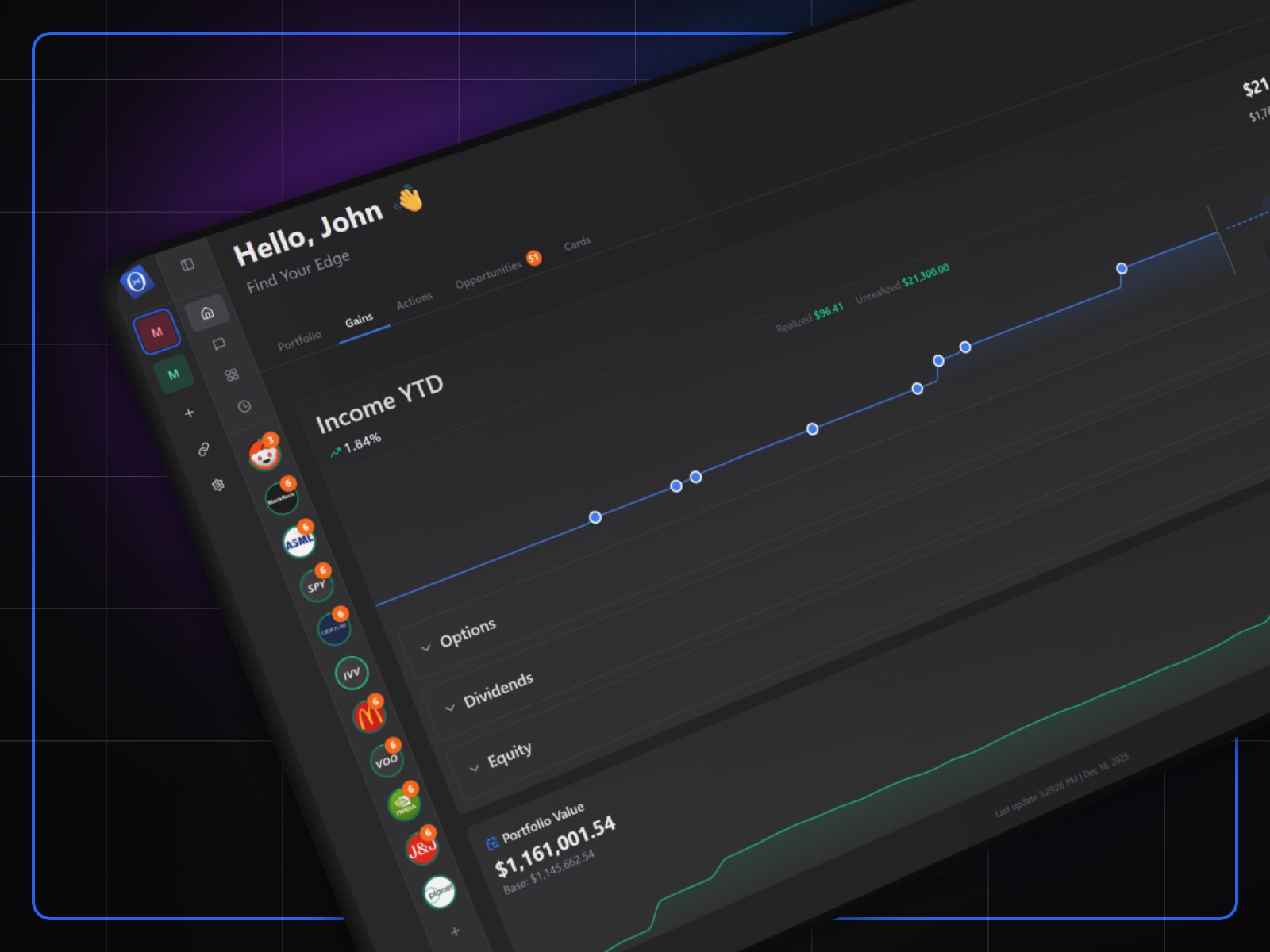
ThetaEdge takes this analysis a step further with a portfolio-focused approach. Instead of starting with a generic list of tickers, it connects securely to over 80 brokerages through read-only access. This lets it evaluate your actual holdings and available cash, tailoring opportunities to your specific situation. To date, ThetaEdge has analyzed more than $26 million in assets, with an average user portfolio size of $300,000. Users collectively have earned over $1.5 million in premiums by leveraging its features.
Each trade suggestion includes a detailed breakdown of strike price, expiration, premium, assignment probability, and breakeven. This unified view makes it easy to compare trade-offs quickly. The platform also introduces Thetix, an AI assistant that models "what-if" scenarios and explains trade ideas in straightforward terms. As Sarah C., a marketing director who uses ThetaEdge, shared:
"I worried I'd have to move all my investments or learn complicated trading tools. But here, I keep my accounts where they are, and everything's explained in plain language".
ThetaEdge offers a 30-day free trial with full access to its features, giving users ample time to explore how its portfolio-aware analysis can simplify cash-secured put strategies. By combining advanced analytics with secure brokerage integration, ThetaEdge supports the principles of strategic decision-making outlined earlier.
Conclusion
Cash-secured puts offer a way to earn income while potentially buying stocks at a discount. The process is straightforward: you sell a put option and set aside enough cash to purchase 100 shares at the strike price if assigned. If the stock price stays above the strike, you keep the premium. If it drops, the premium reduces your effective purchase price.
This approach is most effective when applied to companies you believe in and would feel comfortable holding for two to three years. To manage risk, many traders cap each trade at no more than 5% of their portfolio. Data shows that option buyers lose around 75% to 80% of the time, while roughly 80% of systematic put sellers see their positions either expire worthless or close with a profit.
However, the risks are real. A stock plummeting toward zero could leave you with losses equal to the strike price minus the premium. This makes careful stock selection essential. Many seasoned traders mitigate risk by taking profits early, often after capturing 50%–70% of the maximum premium.
Analyzing strike prices, probabilities, and portfolio Greeks manually can quickly become overwhelming. That’s where tools like ThetaEdge step in. By evaluating your actual holdings and cash, it consolidates risk metrics into one clear view. With a 30-day free trial, you can see how this portfolio-focused tool simplifies decision-making without requiring account transfers or complex setups.
Incorporating these strategies can refine your trading approach. Whether your goal is steady income or acquiring stocks at your desired price, cash-secured puts allow you to use time decay to your advantage. As Spicer, Founder of Options Cafe, explains:
"Cash secured puts let you get paid to wait for stocks you want to own at prices you're willing to pay. It's like getting paid to place a limit order".
FAQs
How do I pick a strike price and expiration?
When picking a strike price, aim for a level that aligns with technical support or a price where you'd be comfortable owning the stock. This often coincides with what you'd consider a fair value for the shares.
As for the expiration date, it depends on your market outlook. Shorter durations can let you collect premiums more frequently, but longer expirations allow the stock more time to move toward your target price.
The key is finding a balance between the premium you collect, the likelihood of the stock being assigned, and how these factors fit with your overall investment strategy.
Can I close or roll a put before expiration?
Yes, you can close or roll a put option before it expires. To close the position, you would buy back the option you initially sold. Rolling, on the other hand, involves closing the current position and opening a new one, usually with a different strike price, expiration date, or both. These strategies give you flexibility to respond to changing market conditions or align with your trading objectives.
What’s the real worst-case loss if the stock crashes?
When the stock's value plummets to zero, you're looking at the worst-case scenario. In this case, your maximum loss equals the strike price, reduced by the premium you collected. While this outcome represents a significant loss, it is capped at the total value of the stock if it becomes worthless. It's crucial to evaluate these risks thoroughly before committing to selling cash-secured puts.