

The Psychology of Patience in Options Trading
Why patience wins in options trading: how brain chemistry and biases drive impulsive moves, plus rules, mindfulness and data tools for disciplined trading.
Patience is a critical skill in options trading, especially for strategies like covered calls and cash-secured puts. The ability to wait for the right setups, resist impulsive decisions, and leverage time decay (theta) can significantly improve outcomes. However, our brains are wired for immediate rewards, making patience difficult. Emotional triggers like fear, greed, and FOMO often lead to poor decisions, such as selling too early or chasing trades during market volatility.
Key insights include:
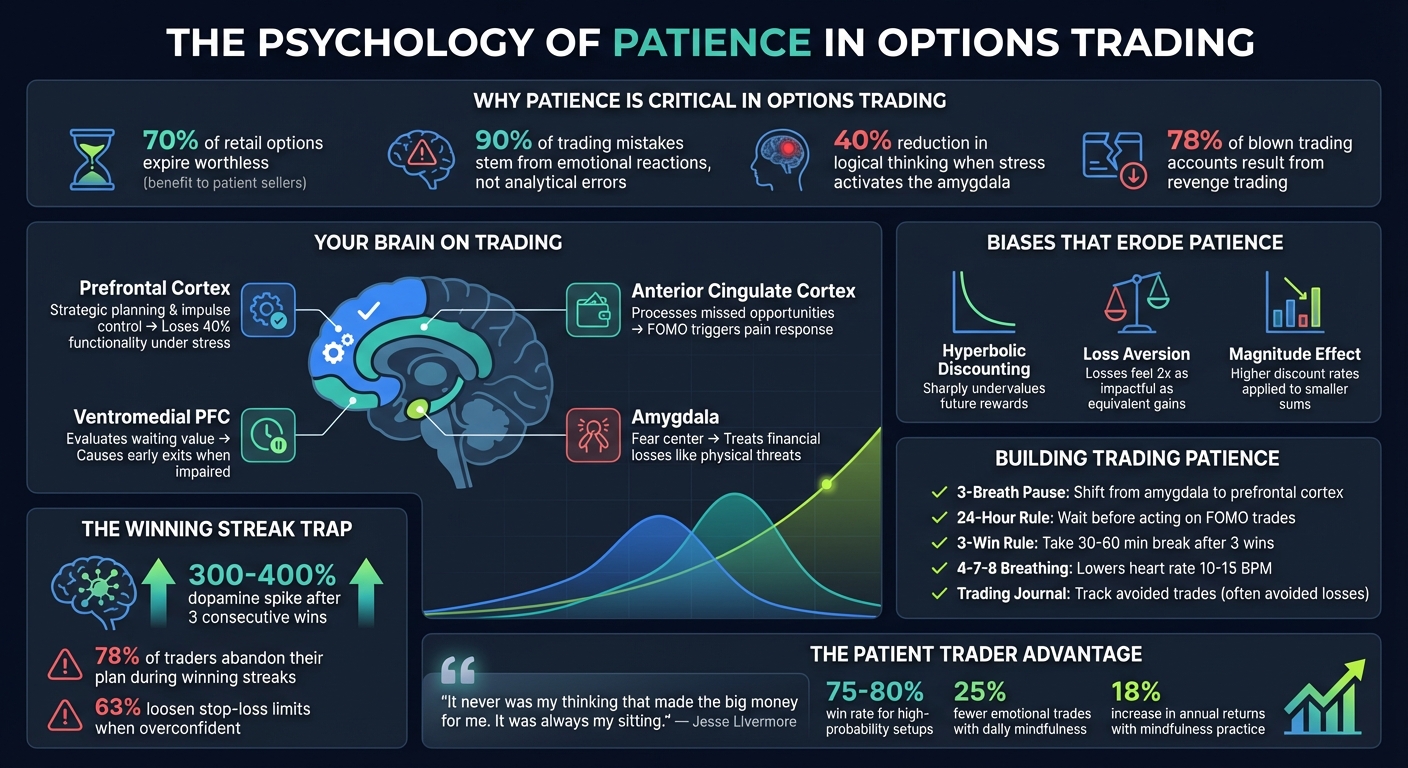
- Theta Decay Advantage: Options sellers benefit as time erodes the option's value, turning premiums into profit. About 70% of retail options expire worthless.
- Biological Challenges: Stress and uncertainty activate the brain's fear center (amygdala), impairing logical thinking by up to 40%.
- Behavioral Biases: Impatience often stems from biases like hyperbolic discounting (favoring immediate rewards) and loss aversion (overreacting to losses).
- Practical Strategies: Tools like trading plans, mindfulness techniques, and data-driven platforms (e.g., ThetaEdge) help traders stay disciplined and avoid emotional mistakes.
Patience isn't just about waiting - it's about making deliberate, well-informed decisions. By understanding the psychology and neuroscience behind trading behavior, you can develop habits that lead to consistent success.
Brain Science and Psychology of Patience in Options Trading
Research on Patience and Decision-Making
Studies on Delayed Gratification
Patience often comes down to a constant reassessment of whether to stick with a decision or change course. A 2012 behavioral experiment at a New Jersey shopping mall offers a fascinating glimpse into this dynamic. Forty participants, aged 18–64, were tasked with earning money over a 10-minute period. The participants were split into two groups. In the "Uniform Distribution" group, where wait times were predictable (0–12 seconds), participants earned a median of $10.69 by persevering. Meanwhile, the "Heavy-Tailed Distribution" group, facing unpredictable wait times, earned only $7.29. Their tendency to abandon waiting for smaller, immediate rewards played a significant role in the earnings gap.
Interestingly, the sequence in which information is presented can shape patience. A 2024 study revealed that when individuals reviewed profit targets before expiration dates, patient decisions under time pressure increased from 58.9% to 65.5%. This has direct relevance for traders: prioritizing profit targets over deadlines can naturally encourage more disciplined decision-making, especially when using an options strategy planner to visualize outcomes.
"Displaying the amount information first makes people more patient, while displaying time information first does the opposite." - Nature Communications
Neuroscience backs this up as well. Research shows that dopamine activity in the ventral tegmental area increases during waiting periods, signaling the perceived value of future rewards. This closely aligns with reinforcement learning models, suggesting that your brain is constantly weighing whether sticking with a trade is worth it.
While these studies underscore the benefits of deliberate decision-making, patience can still be undermined by ingrained biases.
Behavioral Biases That Reduce Patience
Behavioral biases play a significant role in eroding patience, particularly in trading. One such bias, hyperbolic discounting, causes people to sharply undervalue future rewards in favor of immediate gratification. This can lead to preference reversals when tempting short-term opportunities arise. Additionally, loss aversion - where losses feel about twice as impactful as equivalent gains - often results in traders holding onto losing positions too long or prematurely taking profits on winning trades.
Another bias, the magnitude effect, reveals how people apply disproportionately higher discount rates to smaller sums. For instance, someone might prefer $10 now over $15 in a month but choose $15,000 in a month over $10,000 now. This tendency can tempt covered call traders to repeatedly chase small premiums instead of waiting for setups with larger potential gains.
External factors, such as stress, hunger, or cognitive overload, can also amplify these biases. Under such conditions, traders are more likely to abandon patience in favor of immediate relief.
"Temporal expectations act as a powerful and adaptive influence on people's tendency to sustain patient decisions." - Joseph T. McGuire, Department of Psychology, University of Pennsylvania
sbb-itb-a9ac3c2
Why Patience Is Difficult in Options Trading
Emotional Triggers That Lead to Impatience
Our brains aren't exactly wired for calm, especially in the high-stakes world of options trading. When uncertainty hits, it sets off a chain reaction in the brain. The amygdala - often called the fear center - takes over, cutting logical thinking by a staggering 40% when markets move against you. This isn't just a metaphor; it's science.
Adding fuel to the fire, volatility releases cortisol and adrenaline, chemicals that scream, "Do something!" Your body interprets staying put as risky, even when patience might be the smarter move.
Greed and boredom also play mind games. Placing a trade releases dopamine, the same chemical tied to gambling addiction. This creates what's known as a "process addiction", where the act of trading becomes the reward, regardless of whether you're actually making money.
Take the case of Michael Chen, a software engineer who got caught up in the GameStop frenzy of January 2021. Overcome by FOMO, he bought call options just minutes before the market closed at $23 - options that had been priced at $2 earlier that day. Three days later, they expired worthless. Stories like this highlight how emotions can override rational strategies, especially in volatile conditions.
How Market Volatility Affects Patience
Volatility doesn't just increase risk; it messes with your brain's ability to process information. When implied volatility spikes, rapid price changes and theta decay create what researchers call "artificial urgency." This pressure makes you feel like you need to act immediately, even when thoughtful analysis would serve you better.
Consider this: zero-day-to-expiration (0DTE) options now account for 51% of S&P 500 options volume. This shift toward fast-paced, emotionally charged trading drains your mental reserves. By your third or fourth trade in a volatile session, you're likely experiencing "ego depletion" - a state where your self-control is significantly weakened.
"Your brain would rather be wrong quickly than uncertain for longer." - Will Jennings, Apex Trading
Volatility also amplifies regret, especially with near-miss scenarios. In November 2022, a Bitcoin trader named Raj felt this firsthand. Despite having a long-term strategy, he panicked during Bitcoin's drop to $15,500 and sold his entire portfolio. Within two weeks, Bitcoin had rallied to $25,000. That gap between what could have been and what actually happened triggered intense frustration, often leading to revenge trading - a behavior responsible for 78% of blown trading accounts.
The brain's reaction to missed financial opportunities is harsh. The anterior cingulate cortex, which processes pain, treats these misses like physical injuries. Combine that with the fact that losses feel twice as painful as equivalent gains feel pleasurable, and it's clear why volatile markets often lead to impulsive decisions rather than the patience needed for better setups.
How to Build Patience in Your Trading
Patience in trading isn’t just a virtue - it’s a skill that can be developed through planning, emotional control, and leveraging data. By combining psychological principles with actionable strategies, you can create a disciplined approach to trading.
Building a Structured Trading Plan
A solid trading plan is your best safeguard against impulsive decisions. Start by identifying what constitutes an "A+" trade setup. Create a checklist where trades must meet at least 80% of your criteria before you even think about entering. This helps filter out market distractions and avoid what traders often call "meaningless chop."
Keep a trading journal to track missed setups and their potential outcomes. Set measurable goals, such as aiming for a 10% monthly return or sticking to a one-trade-per-day rule. These benchmarks can help you stay focused and reduce impulsive behavior. It’s worth noting that over 70% of day traders lose money, with impatience being a key factor.
"It never was my thinking that made the big money for me. It was always my sitting." - Jesse Livermore, Renowned Trader
Once you’ve established this structure, the next challenge is managing the emotional pressures that can derail even the best plans.
Using Mindfulness to Control Emotions
Mindfulness is a practical way to manage stress and improve decision-making. According to a 2022 study in the Journal of Behavioral Finance, traders who practiced daily mindfulness experienced 25% fewer emotional trades and saw an 18% increase in annual returns.
A simple yet effective technique is the 3-Breath Pause. Before making any trade, take three deep breaths. With the first, notice any physical tension. With the second, identify your current emotion. And with the third, confirm whether the trade aligns with your plan. This method helps shift your brain's activity from the reactive amygdala to the logical prefrontal cortex.
For trades driven by market hype or momentum, consider using the 24-Hour Rule. Wait a full day before acting. If the trade still meets your criteria after the delay, it may be worth pursuing.
"Billionaire hedge fund manager Paul Tudor Jones credited his daily meditation practice for his ability to remain calm during the 1987 'Black Monday' crash, allowing him to stick to his strategy while others panicked."
Making Data-Driven Decisions with ThetaEdge
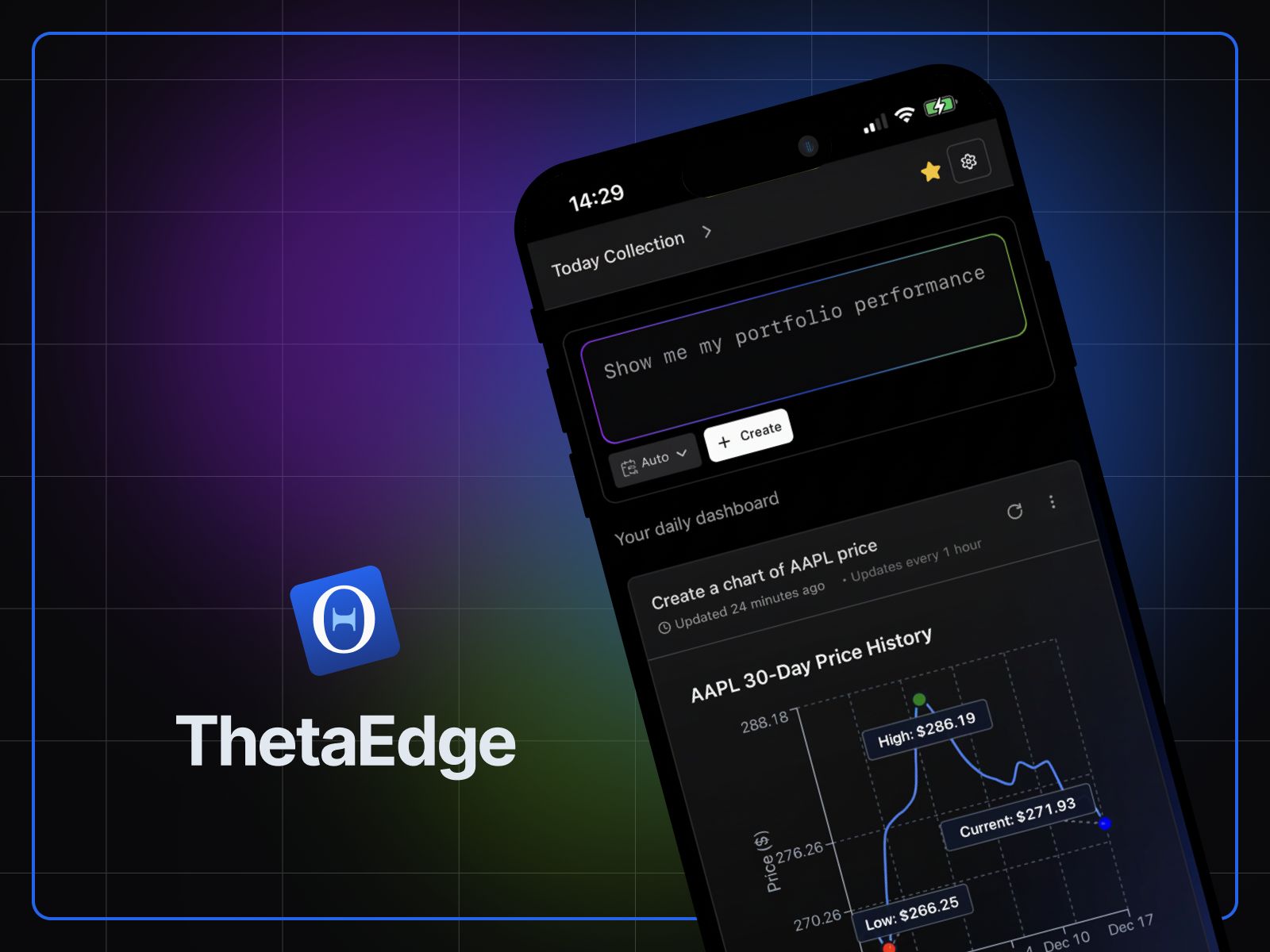
Once you’ve built a plan and strengthened your emotional discipline, data-driven tools can further enhance your patience. Replacing gut instincts with quantitative analysis ensures emotions don’t dictate your decisions.
ThetaEdge is one such tool, offering portfolio-specific covered-call opportunities tailored to the stocks you already own. It provides detailed metrics for each setup, including strike prices, expiration dates, premiums, assignment probabilities, and breakeven points. This level of detail helps you make informed choices without second-guessing.
The platform’s Thetix AI assistant answers plain-language questions about your portfolio, using live market data. It doesn’t recommend trades or execute actions, keeping you in control while providing the insights needed to make thoughtful decisions. Additionally, the daily AI-generated opportunity digest highlights high-quality setups, reducing the urge to overtrade out of boredom or fear of missing out.
When a position expires, ThetaEdge’s roll strategy tools present the next opportunity automatically. This prevents you from scrambling for trades and keeps your approach grounded in structure and data. By clearly outlining risks and trade-offs, the platform helps you stay disciplined and patient in your trading routine.
These strategies, when combined, turn psychological insights into practical habits that can lead to long-term trading success.
Brain Science Behind Patience in Trading
This section delves into the brain's role in why patience is so critical in options trading, focusing on how we process delayed rewards and manage emotions.
How the Brain Weighs Immediate vs. Delayed Rewards
Our brains are wired to value rewards differently depending on timing. When deciding whether to decide on dynamic exit strategies to close a profitable trade early or hold for a bigger gain, your brain engages in a process called delay discounting. Essentially, the longer you have to wait for a reward, the less valuable it feels in the present.
This decision-making involves specific brain regions. The prefrontal cortex is responsible for planning and impulse control - it’s the voice urging you to stick to your strategy. Meanwhile, the ventromedial prefrontal cortex (vmPFC) evaluates whether waiting is worth it. Research shows this area ramps up activity the longer you wait for a reward, essentially weighing the benefit of patience over time.
Brain chemistry also plays a role. Dopamine, the neurotransmitter tied to pleasure and reward, reacts strongly to immediate gratification but dwindles with delayed rewards. However, when a delayed reward finally arrives, dopamine levels surge, making the wait worthwhile. This explains why closing a trade early can feel so tempting - your brain craves the immediate dopamine hit and undervalues the future gain.
"FOMO activates the same neural pathways as physical pain. When subjects watched others receive financial rewards they had 'missed,' their anterior cingulate cortex, the brain's pain center, lit up as if they had been physically injured." - Dr. Mauricio Delgado, Neuroscientist, Harvard University
The anterior cingulate cortex processes the emotional pain of missed opportunities. Watching a stock rally without you triggers this area, making your brain react as if you've suffered a physical injury. This can lead to panic and impulsive decisions, overshadowing logical analysis.
Grasping how your brain perceives rewards provides a foundation for managing emotions during high-pressure trading moments.
Managing Emotions to Improve Trading Performance
Knowing how your brain works is one thing; controlling it is another. Emotional circuits can hijack decision-making, especially during market volatility. During stressful moments, the prefrontal cortex - the brain's rational center - can lose up to 40% of its functionality. Blood flow shifts toward the amygdala, which processes fear and treats financial losses like physical threats.
Stress hormones like cortisol, often triggered by FOMO, further impair the prefrontal cortex. This creates a perfect storm for poor decisions. Studies suggest that 90% of trading mistakes stem from emotional reactions rather than analytical errors.
To counteract this, you need strategies to regain control. The "3-Win Rule" is an effective approach. After three consecutive wins, dopamine levels can spike 300% to 400% above normal, impairing risk assessment. Taking a 30 to 60-minute break after three wins allows dopamine to stabilize. A 2023 University of Chicago study found that 78% of traders on winning streaks abandoned their plans and increased position sizes, while 63% loosened their stop-loss limits or made critical mistakes when rolling.
| Brain Region | Primary Role | What Happens When It Fails |
|---|---|---|
| Prefrontal Cortex | Strategic planning and impulse control | Leads to impulsivity and poor risk management |
| Ventromedial PFC | Evaluates value of waiting | Exits trades too early, undervaluing long-term gains |
| Amygdala | Detects threats and losses | Triggers panic selling and irrational decisions |
| Anterior Cingulate | Processes missed opportunities | Drives FOMO-based trades and revenge trading |
Biofeedback tools can also help. Monitoring your Heart Rate Variability (HRV) can indicate when your amygdala is taking over. A drop in HRV signals an "amygdala hijack", a clear sign to pause trading. Simple breathing exercises, like the 4-7-8 method (inhale for 4 seconds, hold for 7, exhale for 8), can lower your heart rate by 10 to 15 beats per minute, reactivating your prefrontal cortex.
"The vmPFC seems to play a crucial role in evaluating the subjective value of waiting. Damage to this area doesn't just reduce patience; it fundamentally alters how people assess whether persistence is worthwhile in the first place." - Camilla van Geen, Ph.D. Candidate, University of Pennsylvania
Other brain regions, like the dorsomedial prefrontal cortex (dmPFC) and anterior insula, are key for adapting strategies and learning from feedback. These areas help you decide when to stick with or abandon a trade based on changing market conditions. Keeping an "Opportunity Log" of trades you avoided can retrain these circuits. Reviewing this log often reveals that many "missed" trades were actually avoided losses, helping to reframe your brain's response to FOMO.
Conclusion
The brain science we've discussed underscores a key takeaway: patience isn't just a virtue in options trading - it's a serious advantage rooted in neuroscience and psychology. Emotional decision-making is responsible for 90% of trading mistakes, while stress can impair prefrontal cortex function by as much as 40%. Understanding these tendencies is the foundation for developing the discipline that distinguishes steady traders from impulsive ones.
The evidence supports this approach. Waiting for high-probability setups often results in win rates of 75–80%. Jesse Livermore summed it up perfectly:
"It never was my thinking that made the big money for me. It was always my sitting."
Putting theory into practice requires actionable strategies. Tools like the 24-Hour Rule for momentum trades, the 3-Win Rule to manage overconfidence, and defining "no trade" zones help structure a disciplined trading routine. Platforms such as ThetaEdge further reinforce this mindset by shifting focus from impulsive reactions to data-driven decisions, highlighting setups with strong conviction.
Neuroscience also reveals that financial losses activate pain responses similar to physical injury, while FOMO can disrupt cognitive function for hours. Techniques like controlled breathing, pre-trade checklists, and tracking the trades you wisely avoided can help retrain your brain, strengthening the prefrontal cortex's ability to override impulsive urges.
Patience and discipline are the bedrock of professional options trading. Every trade you skip when it doesn't meet your strict criteria isn't a missed chance - it's a deliberate choice to reserve your resources for a genuine opportunity. That's not fear of missing out; that's trading like a pro.
FAQs
How can I tell if I’m trading from FOMO?
FOMO, or the fear of missing out, can creep into your trading decisions when you jump into trades after a significant price swing, disregard your pre-planned entry strategy, or feel an urgent need to act. This behavior often arises from emotional reactions or social influences, both of which can blur your judgment and result in impulsive trading choices.
What rules help me stay patient in volatile markets?
To navigate volatile markets with patience, concentrate on probabilities over predictions and approach risk with respect instead of fear. Developing emotional discipline is crucial to sidestep impulsive choices - something backed by psychological research on trading behavior. Cultivating these habits can lead to steadier decision-making and greater consistency, even under pressure.
How do I use theta decay without overtrading?
To make the most of theta decay while avoiding overtrading, concentrate on selling options and allowing time decay to play out naturally. Aim for positions that are slightly out-of-the-money, typically in the 15-25 delta range, as these provide a good balance between risk and reward. Avoid the temptation to constantly tweak your trades - frequent adjustments can lead to unnecessary costs and complexity.
Instead, set clear exit points ahead of time or use automated tools to help manage your risk. This approach keeps you disciplined and focused. The main objective is to benefit from theta's acceleration as expiration approaches, all without taking on excessive trades or exposing yourself to unnecessary risks.